
AI Agents Have Started Shopping in Europe — and Visa Is Laying the Rails
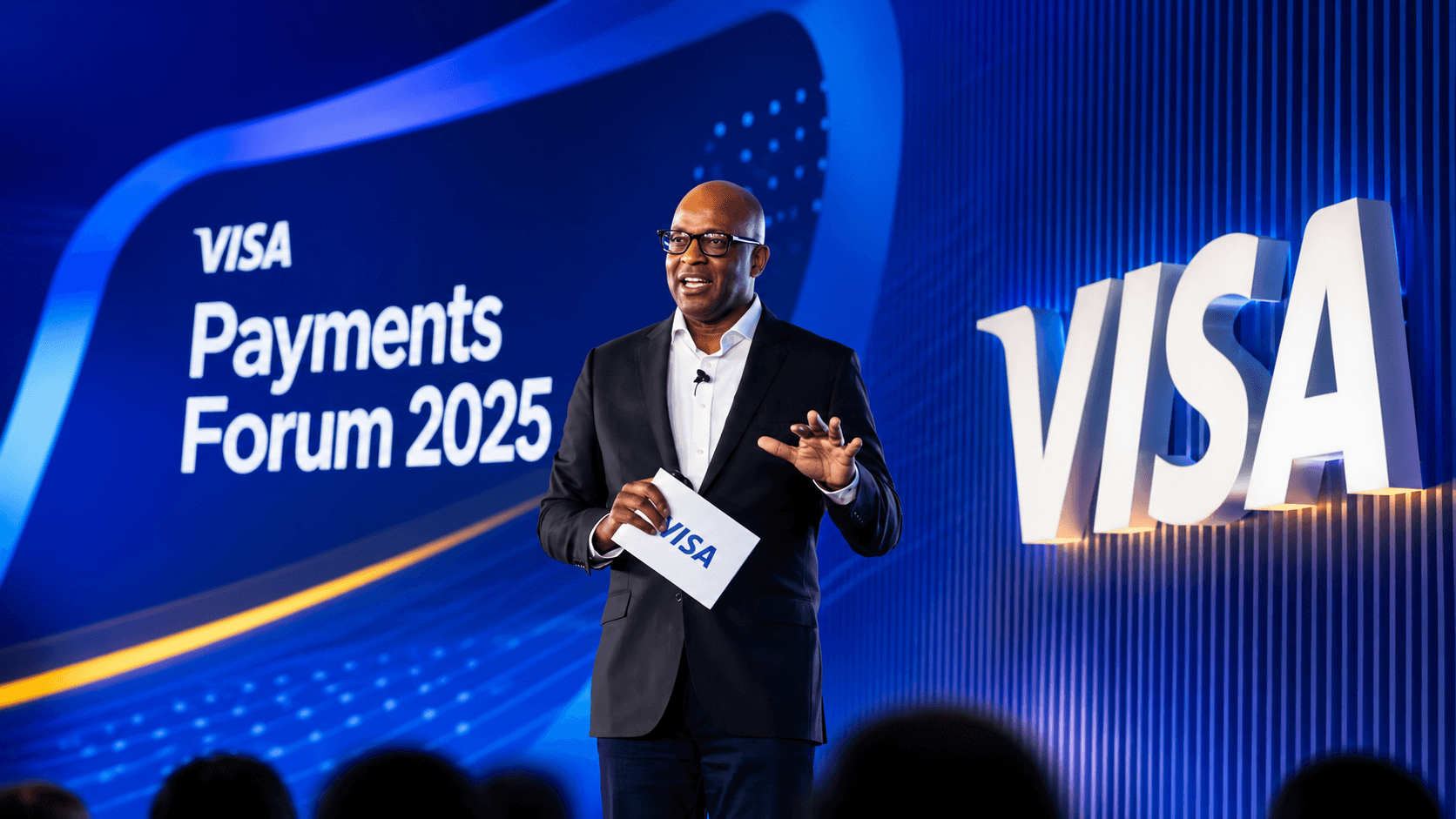
At its Payments Forum in Paris, Visa moved agentic commerce from demo to live checkout, with AI agents buying from real merchants on cardholders' behalf.
The Brief
At the Visa Payments Forum in Paris, which gathered around 2,000 industry leaders, Visa announced that AI agents have completed the first live agentic commerce purchases at independent European merchants — including lastminute.com, Frasers and BrickDepot — secured with Visa Payment Passkeys and compliant with Europe's Strong Customer Authentication rules. The step was unlocked by extending the Agentic Ready programme to merchants via the Trusted Agent Protocol and Agent Directory, with Cloudflare and Akamai supporting rollout and a strategic OpenAI partnership feeding the agent side. Trust infrastructure, not chat interfaces, is emerging as the real battleground.
For months, agentic commerce — the idea that an AI assistant could research, choose and pay for something on your behalf — lived mostly in controlled demos and sandbox storefronts. That changed in Paris on 2 July, when Visa used its annual Payments Forum to confirm that AI agents are now executing real purchases at independent merchant websites across Europe, tied to real cardholders and settled over its network.
The forum, which brings together roughly 2,000 payments leaders, opened with remarks from Visa President Oliver Jenkyn and positioned trust as the connective theme across every announcement: agent-driven checkout, upgraded fraud defences and the plumbing needed to make autonomous payments behave like the payments people already rely on.
From sandbox demos to live checkouts
The headline milestone is deceptively simple: an AI agent, acting on a consumer's instructions, browsed a merchant's site, picked an item and completed the purchase — in a live environment, not a walled test store.
Earlier proof points had been carefully fenced. In March, Visa's newly launched Agentic Ready programme produced its first end-to-end demonstration when Banco Santander used a Spanish-issued Visa credential to let an agent buy a book, running the full authorisation, tokenised payment and settlement loop without manual input. A separate exercise with Worldline and ING in Germany showed an agent transacting within consumer-set parameters while satisfying Strong Customer Authentication.
What Paris added is the open web. Agents are now transacting directly with independent merchants — early participants include travel platform lastminute.com, retail group Frasers and BrickDepot — across travel, retail and e-commerce use cases. In each transaction the agent operated inside boundaries the consumer defined: what to buy, when, and under what conditions.
The missing piece: bringing merchants inside the tent
Until now, Agentic Ready had concentrated on the bank side of the equation — giving issuers a structured path to test agent-initiated payments. Paris marked the programme's expansion to merchants, which Visa describes as the final link needed for genuinely end-to-end agentic transactions.
The mechanism is the Trusted Agent Protocol (TAP), paired with an Agent Directory of verified participants. The problem it solves is an old one wearing new clothes: merchants have spent years training their defences to treat automated traffic as hostile bots and block it. As legitimate shopping agents multiply, sellers need a way to separate a verified agent carrying a real customer's intent from a scraper or a fraud script — without tearing down the bot protections that still matter.
TAP gives merchants cryptographic signals to recognise approved agents and set rules for how those agents can browse catalogues, surface products and complete purchases. Crucially, it slots into merchants' existing risk, policy and user-experience stacks rather than demanding new infrastructure, and rollout is being supported at the edge by Cloudflare and Akamai, whose systems already sit in front of a huge share of merchant websites.
Passkeys keep the human in the loop
The consumer-control question — how do you let software spend your money without losing the ability to say no? — is answered on the issuer side through Visa Payment Passkeys.
Every transaction completed under the programme was authenticated with a passkey, binding the payment to a verified individual and to an explicit instruction that person gave. That design keeps agent-initiated purchases inside Europe's Strong Customer Authentication regime, which is one reason Visa chose Europe as the launch region in the first place: the continent's head start on tokenisation, passkeys and modern authentication makes it the natural proving ground.
The bank roster reflects that. Institutions engaged across the Agentic Ready effort include Barclays, BBVA, CaixaBank, Commerzbank, HSBC UK, ING, Klarna, Lloyds Banking Group, Nationwide, Revolut and Santander, among others — a spread that signals issuers see agent payments as something to shape early rather than react to later.
The playbook echoes contactless: standards first, partners aligned, trust designed in from day one — then scale. — The thrust of Visa Europe's message in Paris
Interoperability over walled gardens
Perhaps the most strategically telling detail is what TAP is not: a proprietary moat. Visa built the protocol to coexist with rival and adjacent standards, including Google's Universal Commerce Protocol and the Agentic Commerce Protocol developed by OpenAI and Stripe.
On the agent side, Visa has struck a strategic partnership with OpenAI, contributing its network, credentialing and security infrastructure so that payments can happen close to the assistants consumers actually use. The logic, articulated by Visa Europe product chief Mathieu Altwegg, is that agents are already reshaping how people discover products; the job now is to let those journeys run all the way through to a completed, trusted purchase instead of stalling at checkout.
That framing hints at where the competitive centre of gravity may move. If an agent, not a person, decides where to shop, the storefront matters less and the credential matters more — whoever authenticates the agent, tokenises the card and settles the payment captures the value, regardless of which interface the shopper talked to.
The AI stack behind the scenes
The Paris announcements sit on top of a broader AI push Visa laid out at the forum series this year, where chief product and strategy officer Jack Forestell framed artificial intelligence and stablecoins as the two structural forces remaking both the front end and the back end of money movement.
One concrete product from that agenda is the Large Transaction Model, an AI system trained on billions of payment records that aims to improve fraud detection while simultaneously lifting authorisation rates and cutting false declines — a trade-off the industry has historically treated as zero-sum. For agentic commerce specifically, that back-office intelligence matters as much as the checkout experience: autonomous purchasing only scales if the network can tell good agents from bad actors in real time.
Visa's own projections are aggressive. The company has said it expects millions of consumers to be completing purchases through AI agents by the 2026 holiday season, building on more than 100 ecosystem partners and a growing bench of agents and enablers integrating directly with its Intelligent Commerce framework. Whether adoption lands on that timeline or a slower one, the direction of travel in Paris was unambiguous: the era in which a human clicks every "buy" button is beginning to close.
Key takeaways
- Agentic commerce went live, not just live-demo. AI agents completed real purchases at independent European merchants including lastminute.com, Frasers and BrickDepot — a step beyond controlled storefront tests.
- Merchants were the missing link. Extending Agentic Ready to sellers via the Trusted Agent Protocol and Agent Directory lets merchants distinguish verified agents from hostile bots without new infrastructure, with Cloudflare and Akamai supporting rollout.
- Passkeys anchor consumer control. Every transaction was authenticated with Visa Payment Passkeys, tying agent purchases to a verified person and explicit instruction — and keeping them compliant with Europe's SCA rules.
- Interoperability is the strategy. TAP is designed to work alongside Google's and OpenAI/Stripe's competing protocols, while a Visa–OpenAI partnership pushes payments closer to the agents consumers actually use.
- The credential is the new battleground. When agents choose where to buy, value shifts from storefronts to whoever authenticates, tokenises and settles — and Visa expects millions of consumers to shop via agents by the 2026 holidays.