
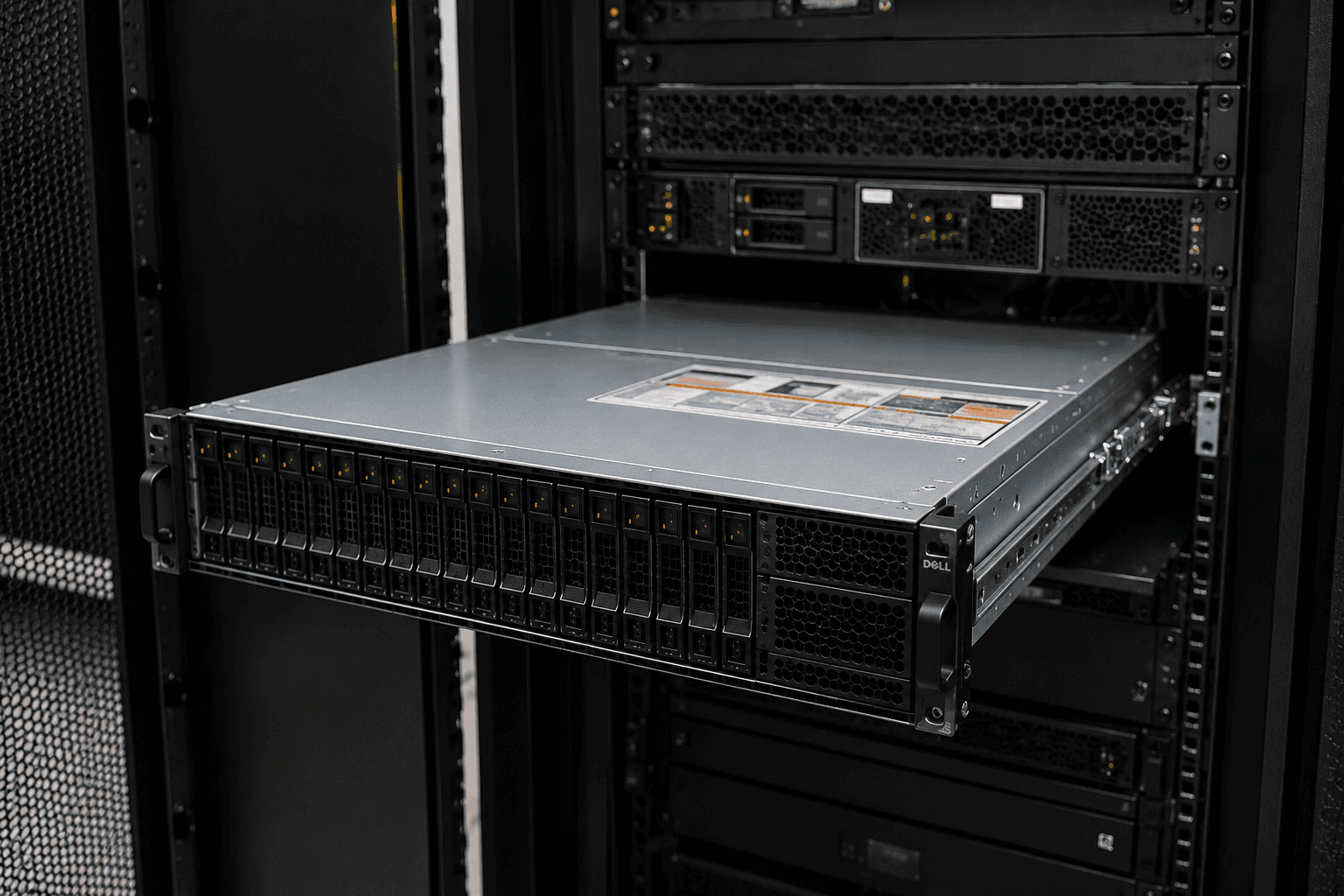
Dell Technologies and KIOXIA Deliver the World's First 9.8 Petabyte Flash Server in a 2U Form Factor — Redefining AI Storage Infrastructure
The relationship between AI capability and storage infrastructure has become one of the defining engineering constraints of the current decade. Generative AI models, large language model training runs, vector databases, and data lake architectures share a common requirement: massive storage capacity available at low latency, with the ability to move data through pipelines at the speeds that modern GPU clusters demand. Tape, spinning hard disks, and even previous generations of flash storage have been struggling to keep pace. Dell Technologies and KIOXIA have answered that challenge with a breakthrough that reshapes the limits of what a single server can hold — delivering an unprecedented 9.8 petabytes (PB) of flash storage in a standard 2U rack unit.
The configuration combines the Dell PowerEdge™ R7725xd server — powered by AMD EPYC™ processors — with 40 KIOXIA LC9 Series E3.L form factor 245.76 TB NVMe SSDs, each representing the world's highest-capacity NVMe SSD for generative AI environments. The system was unveiled at Dell Technologies World 2026 in Las Vegas and marks the first time in the industry that a 2U server has achieved storage density at this scale. To contextualise the magnitude of the achievement: 9.8 petabytes is equivalent to 9,800 terabytes, or 9,800,000 gigabytes — all fitting in a form factor not much larger than a pizza box.
"As AI workloads grow more demanding, the infrastructure supporting them must keep pace. By collaborating with KIOXIA to combine the Dell PowerEdge R7725xd server with their industry-leading LC9 Series SSDs, we are enabling customers to tackle the most data-intensive challenges at unprecedented scale — helping them deploy massive ingestion streams, scale data lakes effortlessly, and deliver AI at the speed and density the next era of computing demands."
— Arun Narayanan, Senior Vice President, Compute and Networking, Dell Technologies
The Technology Breakthrough — BiCS FLASH 8th Gen, PCIe 5.0, and the 245.76 TB SSD
The 9.8 PB figure is made possible by a genuine semiconductor engineering advance. KIOXIA's LC9 Series E3.L SSDs achieve 245.76 TB of flash-based storage through the company's 8th generation BiCS FLASH™ with CBA (CMOS directly Bonded to Array) technology — a stacking architecture that combines 32 two-terabit dies within the E3.L Enterprise and Datacenter Standard Form Factor (EDSFF). This is not simply a higher-capacity version of a conventional SSD — it represents a fundamentally different approach to flash memory density, stacking CMOS logic directly onto the memory array rather than placing it in a separate peripheral region, enabling dramatically higher die density within the same physical footprint.
The LC9 Series delivers PCIe Gen 5 sequential read performance of up to 12,000 MB/s — ensuring that the density advantage does not come at the cost of throughput. For AI workloads where the speed at which training data, model checkpoints, and inference datasets can be read and written is a direct determinant of compute utilisation efficiency, this combination of density and performance is commercially critical. The LC9 Series is available in 2.5-inch, E3.S, and E3.L form factors, with the E3.L format exclusively supporting the full 245.76 TB capacity.
As a point of reference, the LC9 Series 245.76 TB SSD offers approximately 8× the capacity of the 30.72 TB SSDs that remain the more common data centre standard — enabling organisations to achieve the same raw storage capacity in a fraction of the rack space and with significantly lower power consumption per terabyte. KIOXIA describes the LC9 Series as the industry's first NVMe SSD at this capacity built for the specific demands of generative AI environments.
"Our KIOXIA LC9 Series 245 TB QLC SSD isn't just higher density — it's a shift in how we architect AI infrastructures. With the Dell PowerEdge R7725xd server accommodating 40 drives, a whopping 9.8 PB in a single 2U system can be achieved. Customers can deploy massive ingestion streams, scale data lakes effortlessly, and handle large backups in a fraction of the footprint, improving TCO to new levels."
— Neville Ichhaporia, Senior Vice President & General Manager, SSD Business Unit, KIOXIA America
What This Enables — AI Data Management, Data Lakes, and the TCO Transformation
The commercial implications of 9.8 PB in a single 2U server extend well beyond the engineering achievement itself. The constraint that this configuration removes — the need to distribute large-scale storage across many servers and racks — has significant downstream effects on data centre design, operational cost, and AI pipeline efficiency.
AI Model Training and Inference — Complementing GPU Clusters with Matched Storage Density
The Dell PowerEdge R7725xd with KIOXIA LC9 SSDs is designed as a flexible, air-cooled storage configuration that complements GPU-enabled servers — supporting AI data management and model training by delivering massive storage capacity across the AI lifecycle. With support for up to 5 × 400 Gbps NICs, the system enables high-throughput data ingestion that can keep GPU training clusters fully utilised rather than waiting on storage I/O. For organisations where storage bottlenecks are currently limiting GPU utilisation efficiency, this configuration directly addresses the throughput constraint.
Large-Scale Data Lakes — Massive Ingestion, Effortless Scaling
The ability to ingest and store petabyte-scale datasets in a single, compact server changes the economics of data lake architecture. Organisations managing genomics datasets, financial trading records, sensor arrays, satellite imagery, or large-scale log repositories can now consolidate what previously required extensive rack infrastructure into a configuration that occupies a single 2U slot. This consolidation reduces cabling complexity, network hop counts between storage and compute, and the operational overhead of managing distributed storage nodes — directly improving both query latency and data management cost.
TCO Reduction — Fewer Servers, Lower Power, Smaller Footprint
The TCO case for the 9.8 PB configuration is compelling on multiple dimensions. Fewer servers mean less rack space, less power distribution infrastructure, less cooling capacity, and fewer units to maintain. Lower power consumption per terabyte — compared with 30.72 TB SSDs in equivalent configurations — reduces operating cost continuously over the system lifetime. And the data centre footprint reduction enables organisations to accommodate more AI compute capacity in the same physical facility, or to operate existing facilities at higher effective density without capital expansion. For hyperscalers and enterprise data centre operators alike, these cost vectors compound significantly at scale.
The Broader Significance — What 9.8 PB in 2U Means for Data Centre Architecture
The achievement of 9.8 PB in a standard 2U server is a milestone that signals a structural shift in what is architecturally possible in AI-era data centres. For decades, server design was limited by the physical size and density ceiling of available storage drives. With nearly 10 PB now fitting into a standard 2U height — the same form factor as countless servers already deployed in data centres globally — the boundary condition that governed large-scale storage infrastructure design has moved dramatically in favour of density.
This development is also significant for what it signals about the trajectory of flash memory technology. KIOXIA's BiCS FLASH 8th Gen CBA technology has demonstrated that the path to higher capacity runs through vertical stacking and CMOS integration — and the competitive pressure from this milestone will accelerate roadmaps across the flash memory industry toward 300-layer and 400-layer NAND architectures. The companies whose AI infrastructure strategies depend on storage density will benefit from that competition as it plays out in the form of more powerful SSDs and lower cost per terabyte over the coming product cycles.
2U server with AMD EPYC™ processors — supporting 40 E3.L form factor NVMe SSDs, up to 5 × 400 Gbps NICs, and air-cooled operation across enterprise and data centre environments.
245.76 TB, PCIe Gen5, 12,000 MB/s sequential read — 8th Gen BiCS FLASH™ CBA with 32 × 2 Tb dies. Industry's first NVMe SSD at this capacity for generative AI. E3.L exclusive for full 245.76 TB.
9.8 PB total flash storage · 40 drives in 2U · 5 × 400 Gbps NIC support · Air-cooled · Power-efficient vs 30.72 TB SSD baseline · Reduced TCO and data centre footprint vs distributed alternatives.
Key Takeaways
Dell Technologies and KIOXIA have delivered the industry's first 2U server configuration scaling to 9.8 petabytes of flash storage — combining the Dell PowerEdge R7725xd with AMD EPYC processors and 40 KIOXIA LC9 Series E3.L 245.76 TB NVMe SSDs — unveiled at Dell Technologies World 2026 in Las Vegas.
The KIOXIA LC9 Series E3.L SSD — the industry's first NVMe SSD at 245.76 TB capacity for generative AI — achieves its density through 8th Gen BiCS FLASH™ CBA technology stacking 32 × 2 Tb dies, while delivering PCIe Gen5 sequential read speeds of 12,000 MB/s to ensure throughput matches capacity.
The air-cooled configuration supports up to 5 × 400 Gbps NICs for high-throughput AI data ingestion — complementing GPU-enabled servers across the AI training and inference lifecycle — while delivering measurably lower power consumption per terabyte and significantly reduced data centre footprint compared with equivalent configurations using conventional 30.72 TB SSDs.
The milestone signals a structural shift in data centre architecture — with nearly 10 PB fitting in a single 2U slot, the storage density boundary that governed large-scale AI infrastructure design has moved decisively in favour of flash, enabling organisations to consolidate data lakes, reduce TCO, and match storage capacity to GPU compute density. Learn more at kioxia.com and dell.com.
The 9.8 PB flash server represents more than a record-setting product launch — it is evidence that the density constraints which have defined large-scale storage infrastructure for the past decade are being overcome through flash memory engineering at a pace that now keeps up with the most aggressive AI infrastructure demands. Dell Technologies and KIOXIA's long history of collaboration on scalable data-driven infrastructure has produced, in this configuration, the clearest possible statement about where the AI storage market is heading: toward higher density, lower power, smaller footprint, and the elimination of the storage bottleneck as a constraint on what AI infrastructure can achieve.
To learn more about the KIOXIA LC9 Series SSDs and the Dell PowerEdge R7725xd configuration, visit kioxia.com and dell.com.