
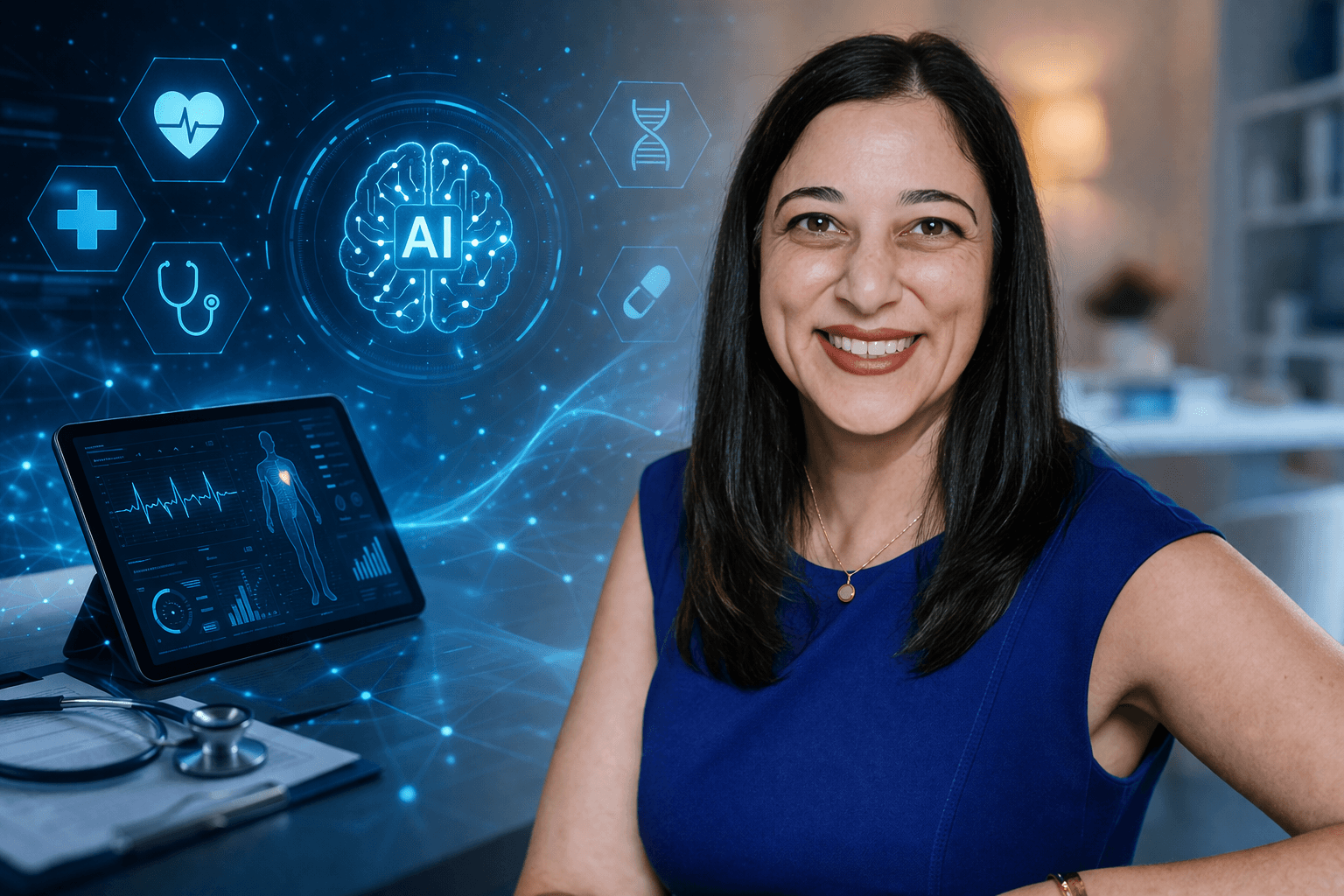
AI-Driven Healthcare: Turning Insights into Action with Nasim Afsar
HealthTech / Clinical Intelligence | 8 min read
The growing use of AI chatbots in healthcare is making medical information more accessible than ever. But an important question persists: will better information actually lead to better health outcomes? Nasim Afsar, Managing Director at Healthcare Innovation Partners, offers a pragmatic lens on what it actually takes to move from AI pilots to real-world impact — and why the hardest challenges are not technical.
ChatGPT Health as a Signal, Not the Destination
Q: You've described ChatGPT Health as 'the first layer' of Intelligent Health. What capabilities must come next for AI to truly improve health outcomes?
"ChatGPT Health helps us interpret and understand our health data, but outcomes require more than comprehension. Intelligent Health must act as a proactive partner — something that continuously identifies risks for harm and opportunities for health and guides action before health deteriorates. That means care that is personalised to the individual, predictive of future risk, preventive in its interventions, and participatory by design — engaging people as active partners in their health. The next layer is realigning the entire health and care ecosystem — providers, payers, pharma, med-tech, employers, retail, and regulators — around the one constant they share: the individual."
— Nasim Afsar, Managing Director, Healthcare Innovation Partners
Afsar also identifies a critical risk in the current moment — mistaking convenience for transformation. AI that explains health data in human terms is a breakthrough, she says, but understanding does not automatically translate into changed behaviour or improved outcomes. More fundamentally, clinical data represents only about 20% of what determines health. The remaining 80% — behavioural, social, environmental, and economic factors — remains largely unintegrated, limiting AI's ability to drive the outcomes people actually need.
The 20% Problem: From Prediction to Prevention
Q: What is the hardest technical or organisational leap required to move AI from explanation to prediction — and from prediction to prevention?
"The hardest leap is moving from decisions based on partial information to decisions grounded in the full reality of a person's life. Today, AI predictions in healthcare are largely built on clinical data generated during care delivery. This represents only about 20% of what actually drives outcomes in conditions like diabetes or hypertension. You wouldn't get on a plane if the pilot told you they had only 20% of the data needed to get you to your destination safely. Yet that's exactly how we manage disease today. Prediction becomes prevention only when we integrate the remaining 80% — behavioural, social, environmental, and economic context — into how health and care are designed and delivered."
— Nasim Afsar, Managing Director, Healthcare Innovation Partners
When Intelligence Doesn't Fail — But the System Does
Q: Where have you seen AI insights fail — not because the model was wrong, but because the system couldn't act on them?
"I've seen this repeatedly in risk prediction — readmissions to hospitals, clinical deterioration, and social risk — where the AI signal was accurate, timely, and clinically meaningful, but no one owned the next step. Alerts surfaced in dashboards or EHR inboxes without clear accountability, capacity, or workflow to act on them. In those moments, intelligence didn't fail; the system did. Without aligned incentives, resources, defined ownership, and operational pathways, even the best AI simply documents risk rather than preventing harm."
— Nasim Afsar, Managing Director, Healthcare Innovation Partners
The Ecosystem Imperative: No Single Company Can Build Intelligent Health Alone
Q: What kinds of partnerships are essential to make Intelligent Health work?
Afsar argues that the technical foundations of Intelligent Health are not the hardest challenge. What is difficult is achieving outcomes, which requires going beyond tools to true ecosystem alignment — delivery systems, payers, pharma, med-tech, employers, retail, and regulators all organising around the individual's goals. She illustrates this with a vision of coordinated diabetes care: personalised grocery credits from insurers activating at checkout, pharmaceutical partners notifying patients of relevant clinical trials, and care teams automatically adjusting medications based on real-time data — all coordinated around improving health, not navigating the system.
The Biggest Misconception: AI Is Not a Panacea
Q: What's the biggest misconception leaders have about AI's role in fixing healthcare?
"The biggest misconception is that AI is a panacea for poor quality, inefficiency, clinician burnout, and rising costs. AI does not eliminate complexity. In fact, it exposes the fault lines already embedded in healthcare. When we layer AI on top of broken incentives, fragmented workflows, and misaligned accountability, we don't fix the system; we scale its dysfunction. We saw this with the electronic health record. Instead of redesigning care around patients and clinicians, we digitised billing and documentation requirements, increasing cognitive burden without improving outcomes. AI will only deliver value if we use it to rethink and redesign healthcare for the modern era — and not simply to automate yesterday's problems."
— Nasim Afsar, Managing Director, Healthcare Innovation Partners
Why AI Pilots Stall — and Who Owns Accountability
On the persistent challenge of AI pilots stalling at clinical adoption, Afsar points to an underestimated force: operational friction. Clinical capacity, workflow disruption, liability concerns, and change fatigue are real constraints. If AI adds cognitive load or uncertainty without reducing work elsewhere, adoption will stall regardless of model accuracy.
On accountability in AI-augmented care, Afsar is clear: responsibility belongs to the organisations and individuals who design workflows, assign ownership, and resource interventions when risk is identified. AI can surface insights, but it cannot own the response — that accountability sits firmly with the humans and systems that determine how insights are acted upon.
Key Takeaways
- • Clinical data represents only 20% of what drives health outcomes — the remaining 80% (behavioural, social, environmental, economic factors) must be integrated for AI to move from prediction to prevention.
- • Intelligent Health requires ecosystem alignment — providers, payers, pharma, med-tech, employers, retail, and regulators all organising around the individual, not the system.
- • AI insights frequently fail not because models are wrong, but because no workflow, accountability, or capacity exists to act on the signal — intelligence doesn't fail; the system does.
- • Layering AI on top of broken incentives and fragmented workflows scales dysfunction — AI must be used to redesign healthcare, not automate yesterday's problems.
- • Accountability in AI-augmented care belongs to the humans and organisations that design workflows and resource responses — AI surfaces risk; people and systems must own what happens next.