
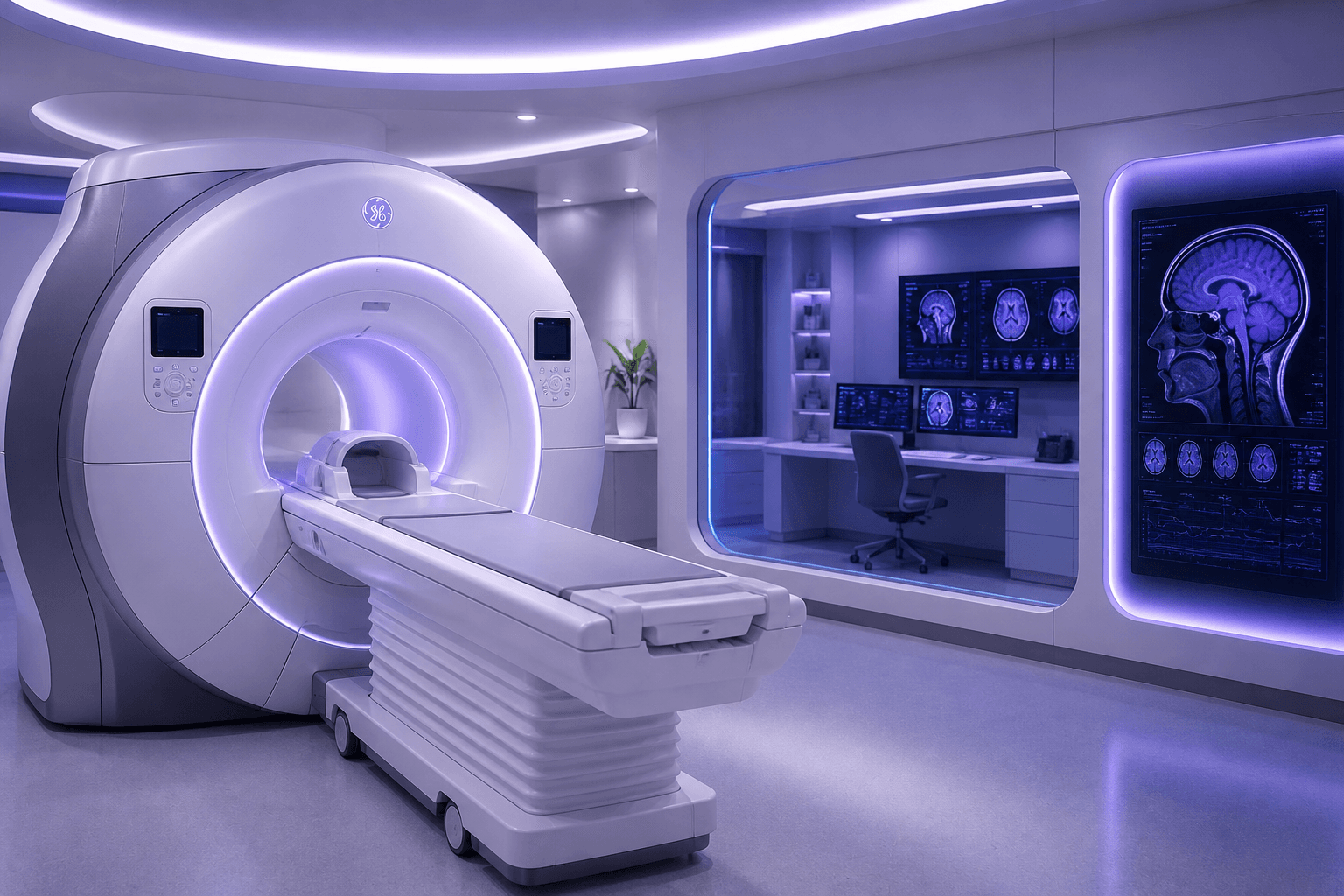
GE HealthCare Advances MRI Imaging with Next-Generation SIGNA MR — Helium-Free, AI-Powered, and Built for the Future of Clinical Research
Magnetic resonance imaging sits at the intersection of some of the most pressing challenges in modern medicine — from the early and accurate detection of cancer and neurological disease to the cardiac imaging that determines treatment pathways for millions of patients every year. The quality of that imaging, the speed at which it is acquired, and the consistency with which it can be reproduced across different sites and study populations directly determines what clinical and research teams can achieve. At the International Society for Magnetic Resonance in Medicine (ISMRM) 2026 Annual Meeting, GE HealthCare (Nasdaq: GEHC) has announced a significant expansion of its next-generation SIGNA™ MR portfolio — combining high-performance hardware, advanced deep learning reconstruction, and a new AI-powered workflow platform in an integrated architecture designed to advance both clinical practice and research discovery.
The announcements span a new deep learning acceleration technique for 2D imaging, the SIGNA One AI-powered workflow ecosystem, the SIGNA Bolt next-generation 3T MRI system, the SIGNA Sprint with Freelium helium-free 1.5T system, and expanded capabilities for AIR Recon DL — each building on FDA 510(k) clearances obtained earlier in 2026. Together, they represent GE HealthCare's most comprehensive MR portfolio refresh in years — and a clear statement of strategic intent as the company accelerates its position in AI-enabled medical imaging.
"Our focus is to enable the research ecosystem that helps researchers explore new questions, scale collaboration and translate discoveries more efficiently to broaden clinical impact. From high-performance systems to collaboration resources for productive MR research, we are committed to giving researchers the tools they need to work together more effectively, explore new frontiers, and accelerate the path from discovery to patient experience."
— Kelly Londy, President & CEO, MR and Women's Health, GE HealthCare
The SIGNA Portfolio — Four Systems, One Unified AI-Native Architecture
What distinguishes the ISMRM 2026 announcements from a typical product refresh is the architectural coherence of the portfolio. Each system — SIGNA Bolt, SIGNA Sprint with Freelium, SIGNA One, and the expanded Sonic DL and AIR Recon DL capabilities — is designed to work within a unified platform rather than as a standalone hardware improvement. The result is a MR ecosystem where deep learning, workflow intelligence, and hardware performance are interconnected rather than additive, and where improvements in one layer compound the value of the others.
SIGNA One — AI-Powered Workflow Ecosystem From Plan to Scan and Beyond
SIGNA One is the AI-powered, next-generation workflow ecosystem that forms the foundation of GE HealthCare's latest MR capabilities. Designed to simplify complexity and enable more consistent imaging across clinical and research environments, it addresses inefficiencies throughout the entire MRI workflow — helping increase throughput, reduce variability, and improve the experience for researchers, technologists, and patients. Core capabilities include an intuitive, AI-guided user interface designed to minimise training time across varying user experience levels, and one-click switching between clinical and research modes within a single exam for seamless integration of research protocols into clinical workflows.
SIGNA Bolt — Next-Generation 3T MRI with Deep Learning and Sustainability Focus
Built on the SIGNA One platform, SIGNA Bolt is GE HealthCare's FDA 510(k) cleared next-generation 3T MRI system — featuring an advanced 80/200 gradient system that delivers research-level performance with approximately 30% lower power consumption than previous-generation systems. A new AIR Coil suite enhances patient comfort and operational flexibility, including feet-first capabilities across exams to better support claustrophobic patients and reduce costly rescans. SIGNA Bolt provides end-to-end advanced solutions supporting care pathways across neurology and oncology.
SIGNA Sprint with Freelium — Helium-Free 1.5T MRI Without Operational Compromise
SIGNA Sprint with Freelium eliminates the vent pipe requirements and helium dependency that have historically constrained where MRI systems can be sited — with less than 1% helium usage, no vent pipe, and the same power infrastructure as conventional magnet technology. Identical high homogeneity specifications ensure the same excellent image quality as conventional systems, while the ventless magnet design enables installation in virtually any clinical environment. Following its introduction at ISMRM 2025, the high-gradient 1.5T system is now enabling advanced clinical applications across cardiology and oncology.
Sonic DL for 2D Imaging — Deep Learning Acceleration Across 85% of MR Exams
Building on the Sonic DL platform established for cardiac cine and 3D imaging, GE HealthCare has announced FDA 510(k) pending status for Sonic DL for 2D imaging beyond cardiac cine — extending deep learning acceleration to cover up to 85% of MR exams. Enhanced by compatibility with AIR Recon DL for 2D and 3D imaging, the technology further improves image quality and Signal-to-Noise Ratio (SNR) of accelerated exams, reducing scanning and examination times across the breadth of clinical MR applications.
Clinical Validation — Real-World Impact at AZ Delta in Cardiology
The clinical evidence presented at ISMRM 2026 by teams at AZ Delta in Belgium illustrates how the SIGNA Sprint Elite's combination of advanced gradient performance and deep learning reconstruction translates into practical clinical benefit. Cardiac MRI has historically been one of the most technically demanding and time-intensive MR applications — requiring specialised expertise, careful patient cooperation, and extended scan sessions that limit throughput and challenge both patients and clinical teams.
"SIGNA Sprint Elite finally bridges the gap between high-performance cardiac MRI and real clinic scalability. The system enables high-quality imaging at significantly reduced acquisition times — a decisive advance for both the patients we serve and the clinical teams delivering the examination."
— Dr. Kristof De Smet, PhD, Chairman of the Medical Board, AZ Delta, Belgium
Research Collaboration Tools — Accelerating the Path From Discovery to Clinical Impact
Beyond hardware and deep learning, the ISMRM 2026 announcements extend into the research ecosystem infrastructure that determines how quickly scientific discoveries move from an academic MR programme into clinical practice. GE HealthCare's research collaboration tools are designed to address a persistent bottleneck: the translation gap between discovery in a single high-performance research centre and validated, reproducible findings that can be adopted across the broader clinical community.
The SIGNA One platform's one-click switching between clinical and research modes — enabling seamless integration of research protocols within clinical workflows — directly addresses this translation problem. By making it operationally straightforward for clinical sites to run research protocols alongside their standard patient workload, it dramatically lowers the barrier to multi-site research participation and the collection of the large, consistent datasets that advanced MR research requires.
SIGNA Sprint Elite validated for high-quality, time-efficient cardiac MR — with advanced gradient performance and deep learning reconstruction enabling scalable cardiac imaging across clinical environments of varying capability.
SIGNA Bolt and SIGNA Sprint Elite support advanced oncology imaging pathways — with deep learning reconstruction and improved SNR enabling the image quality that precise tumour characterisation and treatment planning demands.
End-to-end solutions for neurology care pathways supported by SIGNA Bolt — with research-level 3T gradient performance enabling the high-resolution, high-contrast brain imaging that neurological diagnosis and research programmes require.
Key Takeaways
GE HealthCare has announced a major expansion of its next-generation SIGNA MR portfolio at ISMRM 2026 — spanning the SIGNA One AI workflow ecosystem, SIGNA Bolt 3T MRI system, SIGNA Sprint with Freelium helium-free 1.5T, and Sonic DL deep-learning acceleration for 2D imaging, all built on FDA 510(k) clearances obtained earlier in 2026.
Sonic DL for 2D imaging extends deep learning acceleration to cover up to 85% of all MR exams — significantly expanding on previous coverage of cardiac cine and 3D imaging, and reducing scanning and examination times across the broadest range of clinical MR applications.
SIGNA Sprint with Freelium eliminates vent pipe requirements and helium dependency with less than 1% helium usage, maximum siting flexibility, and identical image quality to conventional magnet systems — while SIGNA Bolt delivers research-level 3T gradient performance with approximately 30% lower power consumption than previous-generation systems.
SIGNA One's one-click switching between clinical and research modes — enabling research protocols to run within clinical workflows — directly accelerates the translation path from MR discovery to clinical impact, removing the operational barriers that have historically slowed multi-site research participation. Learn more at gehealthcare.com.
The ISMRM 2026 portfolio announcements from GE HealthCare represent a coherent and ambitious articulation of where MR imaging is heading — toward systems that are simultaneously more capable, more sustainable, more accessible, and more tightly integrated with the AI and workflow layers that determine how efficiently clinical and research teams can operate. The combination of helium-free hardware, deep learning reconstruction covering 85% of exams, and an AI-driven workflow platform that bridges clinical and research modes in a single scan session is not incremental progress — it is a meaningful architectural shift in what MRI can deliver as a platform for both patient care and scientific discovery.
To explore the full next-generation SIGNA MR portfolio, visit gehealthcare.com/products/magnetic-resonance-imaging.