
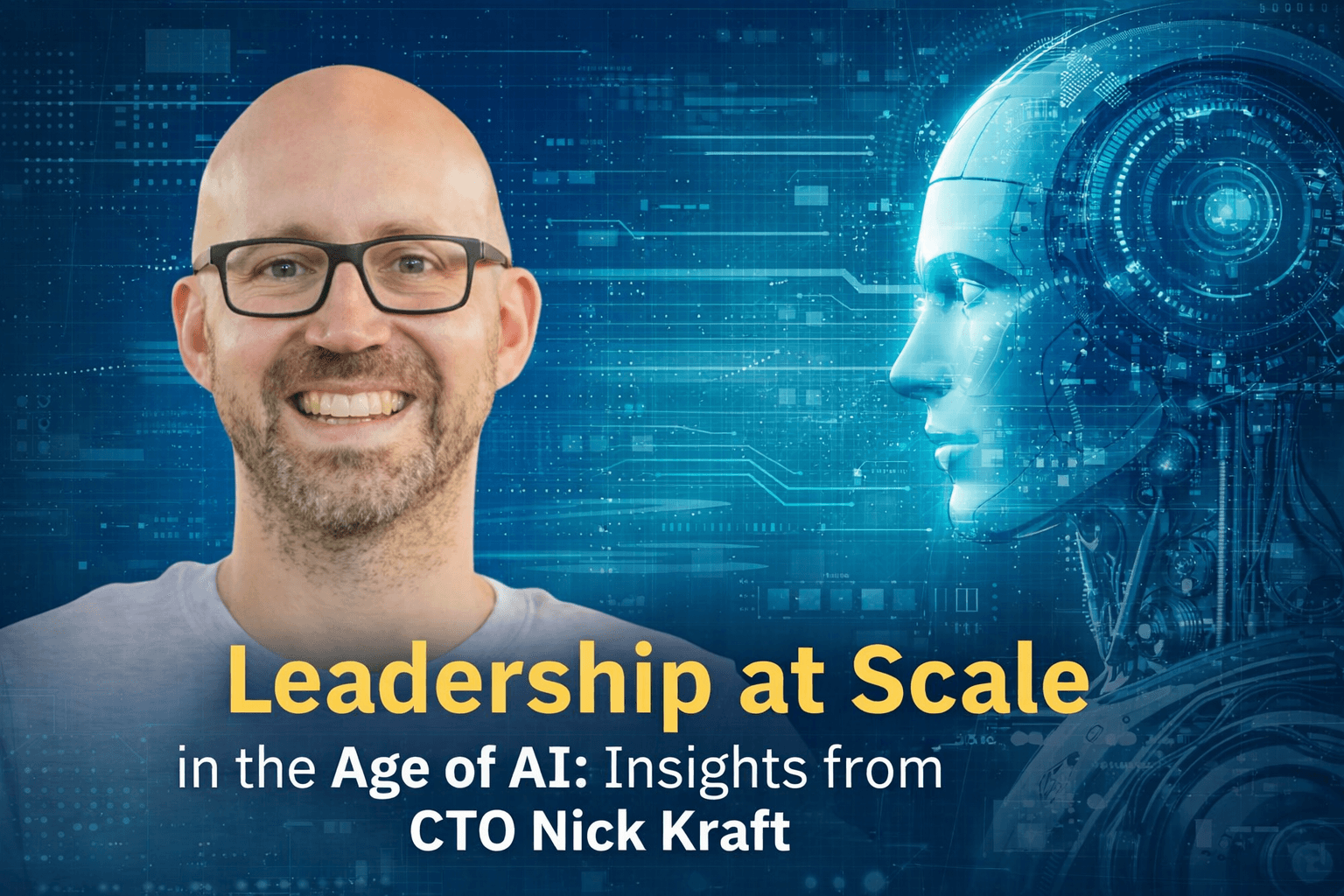
Leading at Scale: CTO Nick Kraft on Building Teams, Trust, and AI Systems
AI / Machine Learning | 8 min read
Modern CTO leadership is no longer defined by technical brilliance alone. Today's CTO operates at the intersection of architecture, culture, risk management, product velocity, and AI reliability — all while scaling teams without becoming the bottleneck. In this interview, Nick Kraft, CTO of Fathom, offers a grounded blueprint for navigating that transition — from founding engineer to organizational leader — and what it truly takes to build AI-powered systems that customers can rely on.
The Evolution from Builder to CTO
Q: You joined Fathom as a founding engineer and recently stepped into the CTO role. What fundamentally changed in how you spend your time — and how you think about impact?
"While I still ship code and do code reviews as CTO, the role is really about making work happen by eliminating barriers for my team. I absorb as much of the administrative and non-technical work as possible so they can focus. My goal is to give engineers the same kind of experience I had early on, where they can zero in on their craft without worrying about the overhead that comes with a growing organisation. Trust and focus are crucial components of the company's success."
— Nick Kraft, CTO, Fathom
Avoiding the Bottleneck: Managing Risk, Not Eliminating It
Q: As a CTO stepping into ownership of systems you originally built, how do you avoid becoming the bottleneck — or the default chief firefighter?
"We're managing a large risk portfolio; running a lean organisation means making decisions about what to prioritise in terms of focus. I could have my engineers working on nothing but mitigating risks that may never be realised. It's about being judicious, taking that global context, and focusing on what matters today rather than becoming scared of our own shadow. We don't want to take productivity away from pushing the product forward because we anticipate something might 'break.'"
— Nick Kraft, CTO, Fathom
Letting Go: Technical Decisions and Bidirectional Trust
Q: What was the most difficult technical decision to let go of as you transitioned from hands-on builder to organisational leader?
"Nothing is sacred just because I did it or because a particular person did it. The nice thing about growth is you hope to bring in people who can do the job even better than you can. My goal is to provide them with the context behind past decisions so the team can make their own assessments. You hire people because you trust them, and once they're on the team, it's important to put that trust to work. That trust goes both ways — you need people who are willing to say 'Hey, I have an idea that I think may work better' but also 'You're right, maybe that's not the direction we want to go today.'"
— Nick Kraft, CTO, Fathom
What Prepared Him Least — and What Mattered Most
Q: What prepared you least for the CTO role — and what ended up mattering most?
"Being a professor definitely helped prepare me for this role. During that time, I had to recruit and fund graduate students — you become responsible for their livelihood in a lot of ways. That environment forces you to build deep mutual trust. I see the same dynamic when I coach my youngest son's soccer team. If I can look a player in the eye and tell him I believe in him and that he can do this, he trusts what I'm saying and will go for it. At the core, communicating that trust is everything. It allows me and my engineers to achieve really cool outcomes together."
— Nick Kraft, CTO, Fathom
Preserving Engineering Rigour While Leading at Scale
Q: How do you preserve engineering taste and technical rigour when you're no longer writing the majority of the code?
"We exclusively hire senior engineers who can come in, see how we're doing things, and use their experience to adapt and understand why we've chosen to do it that way. Then we decide together whether to continue in that direction. We are process-light and meeting-light, but we have core principles we believe in. Once there's trust, as the team grows, nothing is sacred — and we adapt together."
— Nick Kraft, CTO, Fathom
Leadership That Doesn't Change With Scale
Q: What changes in leadership approach when your teams are scaling faster than your ability to personally mentor every engineer?
Kraft is candid: as the team grows and a formal middle management layer hasn't yet been added, cultural touchstones and senior team members help set the tone for new hires. Not everything ends up exactly as originally described — and Kraft says that's fine. The organisation is a living thing. What he holds constant is his approach: remaining pragmatic and approachable, making everyone feel seen and heard, regardless of how many people are in the org. He has heard himself described as "salty" — in a fun way, not a grumpy one — and he's happy with that. The goal is simply to be himself.
Key Takeaways
- • The CTO role is not a sudden shift — it is a progression from eliminating your own bottlenecks to eliminating bottlenecks for your entire team so engineers can focus on their craft.
- • In lean, high-growth AI environments, the job is not to mitigate every possible risk — it is to be judicious about what risks are worth taking today, keeping productivity pointed at shipping product.
- • Trust is not just a leadership value — it is a structural tool. Bidirectional trust enables engineers to challenge decisions and CTOs to let go of ownership while maintaining accountability.
- • Engineering rigour at scale is preserved through hiring senior engineers who understand past decisions and then trusting them to adapt — not through locking down patterns or enforcing process.
- • Leadership approach should not change as a team scales — the goal is to remain pragmatic, approachable, and to make every person feel seen and heard, regardless of org size.