
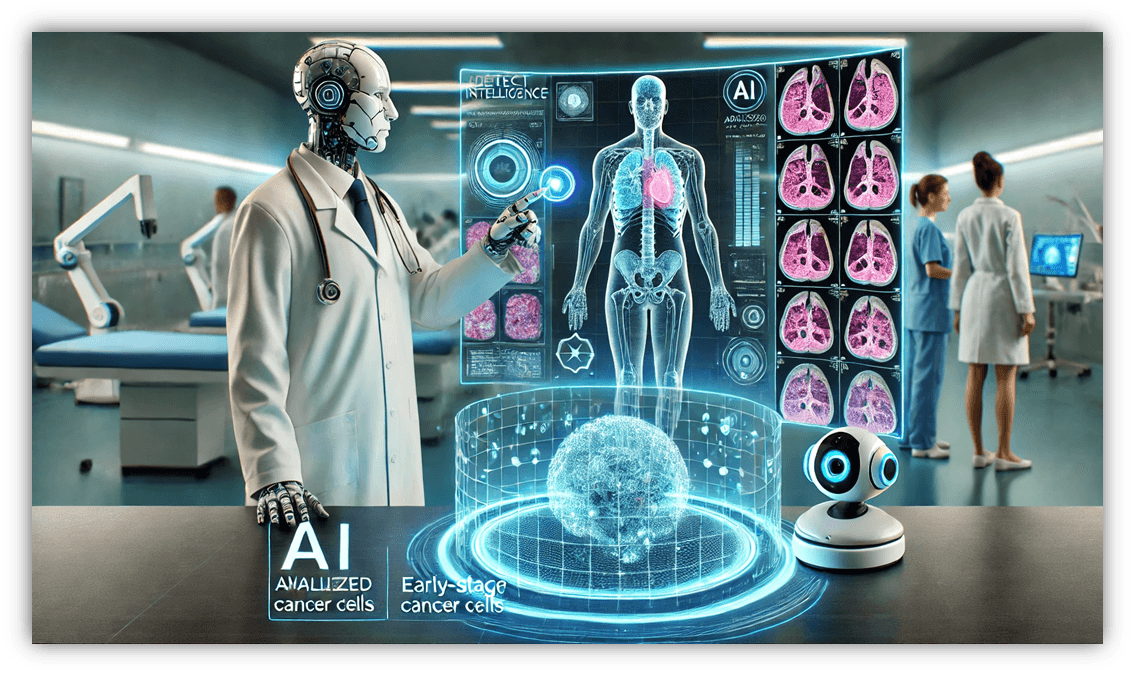
Discover how AI is revolutionizing cancer care through precision diagnosis, open-source innovation, and enhanced patient outcomes.
Many of us know someone who has been affected by cancer. Groundbreaking AI technology is already transforming cancer diagnosis—detecting even the tiniest and rarest cancers invisible to the human eye, mapping their extent with pinpoint accuracy, and enabling oncologists and pharmaceutical teams to deliver highly targeted, precision treatment.
This isn’t just a glimpse of the future. It’s the reality of what AI can achieve today, revolutionizing cancer care by decoding complex data and improving both diagnosis and treatment outcomes.
One of the most significant advancements in AI for pathology is the development of foundation models trained on extensive and diverse datasets. These models enable a variety of downstream applications, from disease detection to prognostic predictions.
The ongoing challenge continues to rest with widespread adoption. As healthcare systems navigate these hurdles and progress toward implementation, advancements in AI will continue to evolve and expand in cancer care. When these paths converge, we stand to witness remarkable breakthroughs in the field, further solidifying AI’s role in cancer diagnosis and treatment.
The Power of Open-Sourcing AI
Open-sourcing AI foundation models is a game-changing strategy that democratizes access to cutting-edge technology and empowers AI developers, academic researchers, and innovators to collectively advance cancer care. This approach accelerates the industry’s progress by enabling these groups to push the boundaries of science, research, and technology for the greater good.
This trend not only fosters a spirit of collaboration but also encourages rapid experimentation and iteration, leading to breakthroughs that can transform patient outcomes. It levels the playing field for smaller organizations, allowing them to leverage existing open-source models to build their applications. As this ecosystem expands, it increases the number of contributors and accelerates the transformation of cancer care.
Breaking Barriers in Cancer Care
The global landscape of cancer care is fraught with challenges, including a critical shortage of pathologists, inequitable access to specialized care, and disparities in expert-level diagnoses and treatment options. These issues are further exacerbated by the rising incidence of cancer worldwide, leaving many hospitals and healthcare systems ill-equipped to meet the growing demand.
By leveraging AI, we can overcome the current limitations and create a future where precision medicine is accessible to everyone, everywhere. AI provides a scalable solution to the pathologist shortage, enabling faster processing of diagnostic slides and ensuring patients receive timely and accurate results. This trend aligns with the growing influence of open-sourcing AI and the development of innovative approaches to dismantling barriers in cancer care while enhancing patient outcomes.
How AI’s Role is Set to Evolve
In the next decade, AI is poised to fundamentally revolutionize cancer care by developing intelligent systems that enable humans to make better decisions across various aspects of the field.
1. Transforming Pathologists’ Roles
AI will automate routine tasks and simplify diagnostic reporting, fundamentally reshaping the role of pathologists. This evolution will elevate their expertise, empowering them with advanced tools to make accurate and insightful diagnoses. The result is enhanced precision in cancer detection and more effective treatment plans.
2. Supporting More Personalized Care
AI will provide richer insights into the nuances of cancer, facilitating more personalized treatment strategies. By integrating AI-driven data, oncologists will gain access to pathology-derived insights that enhance their ability to choose the most effective treatment paths. For example, AI can identify specific mutations at the pathology level that might otherwise go unnoticed, helping determine eligibility for clinical trials and improving outcomes by tailoring therapies to individual needs.
3. Revolutionizing Drug Development
AI will streamline and accelerate drug development, significantly reducing time and cost. By identifying the most effective drugs for specific patient profiles, we enter a new era of precision medicine. AI will facilitate more efficient clinical trials, quantitatively assess drug performance, and improve overall treatment efficacy.
Explore ITech360hub for the latest advancements in AI, IoT, Cybersecurity, AI Tech News, and expert insights driving innovation in healthcare and beyond.