
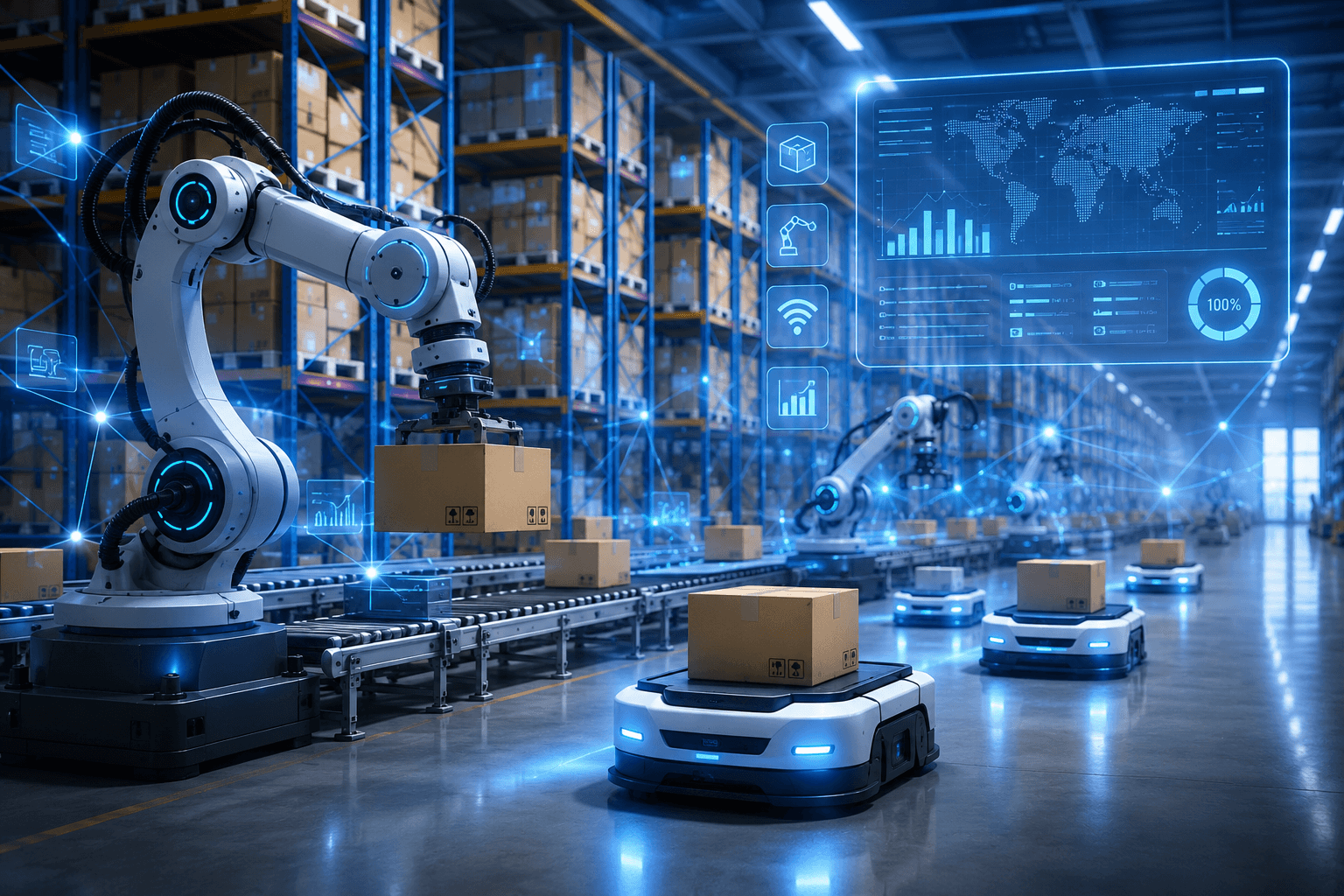
SAP and Cyberwave Deploy Fully Autonomous AI-Powered Robots in a Live Logistics Warehouse — Physical AI Moves from Concept to Operation
The gap between a compelling robotics demonstration and a robot performing real work in a live industrial facility has historically been measured in years — years of integration engineering, task programming, environment mapping, and iterative failure before autonomous systems could be trusted with production operations. That gap is closing faster than almost anyone in enterprise logistics anticipated. SAP SE (NYSE: SAP) and Cyberwave, an AI robotics software company, have announced the successful deployment of fully autonomous, AI-powered robots in an active SAP logistics warehouse — performing box folding, packaging, and shipping fulfilment tasks entirely without human intervention, and delivering measurable throughput improvements in live production conditions.
The deployment is at SAP's warehouse in St. Leon-Rot, Germany, operated on SAP Logistics Management (LGM) — the company's cloud-native logistics execution solution. Building on SAP's strategic expansion of Physical AI capabilities announced the previous year, this initiative marks the moment at which SAP stops announcing what Physical AI will do and demonstrates what it is already doing — inside its own facilities, on live operations, at production scale. The entire integration, from robot training to live operation, was completed using SAP Business Technology Platform (BTP) and the Cyberwave platform.
"By integrating AI-powered robotics directly into our live warehouse operations, we are proving that Physical AI is no longer a concept — it's delivering real value today. At our St. Leon-Rot warehouse, SAP LGM provides the digital backbone that allows robots to be deployed quickly, operate reliably, and scale with our processes. This is a decisive step toward more resilient and efficient logistics operations."
— Tim Kuebler, Head of Warehouse & Shipping, SAP
Why Logistics Robotics Has Been So Hard — And Why This Deployment Signals a Structural Shift
Logistics warehouses are among the most challenging environments for robotic automation — and the difficulty is not primarily mechanical. It is variability. Robots must handle objects of different sizes, shapes, weights, and packaging types. They must work in environments where layouts change, product assortments shift, and conditions across shifts are never precisely identical. Traditional robotic systems address this through hand-coded task scripts — a painstaking engineering process where every variation in object or environment requires a new programming cycle that can take weeks of specialist work to complete.
The consequence has been that conventional warehouse automation works well for highly structured, high-volume, low-variability tasks — pallet movement on fixed routes, for example — but consistently breaks down when applied to the high-variability, physically demanding tasks that still require human workers: folding boxes of different sizes, packing irregularly shaped items, processing mixed shipments. These are precisely the tasks that SAP and Cyberwave are now automating at St. Leon-Rot.
The shift that makes this possible is Cyberwave's approach to robot training — replacing hand-coded scripts with machine learning models that generalise across variability. Robots are no longer programmed for specific object configurations; they are trained on real warehouse data and learn to adapt. The result is a system that can handle the full range of physical variability present in a live logistics environment — not just the subset that engineers had time to script.
"Partnering with SAP on a live warehouse deployment is a defining moment — not just for Cyberwave, but for what AI-powered robotics can actually deliver in enterprise logistics today. What makes this possible is the combination of SAP LGM's robust digital backbone and Cyberwave's ability to collect real-world training data and fine-tune VLA and RL models that generalise across the variability you find in any real warehouse. Robots no longer need to be painstakingly programmed for every object or scenario — they learn, adapt, and keep improving. That's the shift we've been building toward."
— Simone Di Somma, Co-Founder & CEO, Cyberwave
How the Integration Works — SAP LGM, BTP, Embodied AI Service, and the Cyberwave Platform
The architecture of the St. Leon-Rot deployment reflects a deliberate integration strategy built on SAP's existing enterprise infrastructure rather than a standalone robotics system running in parallel. By grounding robotic actions in SAP's transactional and master data — through SAP LGM and SAP BTP — the deployment ensures that robots are not operating independently of the warehouse management system but as additional participants on the SAP stack, executing tasks in full coordination with the broader logistics operation.
SAP Logistics Management (LGM) — The Digital Backbone for Robotic Automation
SAP LGM's lean, API-first architecture — which drew significant attention at LogiMAT 2026 for its rapid implementation and standardised processes — provides the ideal foundation for robotic integration. By anchoring robot task execution in LGM's warehouse management layer, the deployment ensures that every robotic action is grounded in SAP's transactional data — respecting process controls, compliance requirements, and operational logic that enterprise logistics demands.
SAP Embodied AI Service & BTP — Tasks Translated to Robot Commands in Minutes
The SAP Embodied AI Service translates warehouse tasks defined in SAP LGM into precise robot commands — with end-to-end integration completed via SAP Business Technology Platform in a matter of minutes rather than weeks of custom engineering. This API-first approach means that as the warehouse operation evolves, robot task sets can be updated and redeployed rapidly — eliminating the fragility of conventional systems where even minor changes require extensive re-engineering.
Cyberwave VLA & RL Training Platform — Robots That Generalise, Adapt, and Improve
Cyberwave's platform enables operators to collect real-world training data through intuitive demonstration interfaces — capturing the task variability that exists across real warehouse shifts, product assortments, and layouts. Vision-Language-Action (VLA) and Reinforcement Learning (RL) models are fine-tuned on that data, producing robot policies that generalise across object types, orientations, and workflow variations rather than memorising scripted motions. Real-time feedback loops allow continuous refinement as conditions evolve — meaning the robots get better over time without engineering intervention.
What This Deployment Means for Enterprise Logistics — A Replicable Template
SAP is positioning the St. Leon-Rot initiative explicitly as a reference implementation — a template for how its customers could apply Physical AI within their own logistics environments using SAP LGM and SAP BTP as the core integration layer. By operating the deployment in its own warehouse first, SAP is not simply demonstrating a partner technology — it is validating the architecture, refining the implementation playbook, and generating the operational track record that enterprise customers require before committing to transformation at scale.
The framing of robots as additional "clients" on the SAP stack — rather than standalone automation systems — is strategically significant. It means that organisations already running on SAP can extend their existing process and data governance to robotic automation without building a parallel infrastructure. The integration path is through the platforms they already operate, and the governance they have already established applies to robot task execution from day one.
Fully autonomous box folding across variable box sizes and materials — a physically demanding, highly repetitive task that has historically required dedicated human workers across every warehouse shift.
Autonomous packaging of items across variable product types, orientations, and order configurations — enabled by Cyberwave's VLA and RL models that generalise across the full range of packing variability in a live warehouse environment.
In-house shipping fulfilment completed fully autonomously — from order processing through to despatch preparation — with robot task execution grounded in SAP LGM's warehouse management layer and continuously updated via SAP BTP.
Key Takeaways
SAP and Cyberwave have deployed fully autonomous AI-powered robots in a live logistics warehouse at SAP's St. Leon-Rot, Germany facility — performing box folding, packaging, and shipping fulfilment entirely without human intervention, and delivering measurable throughput improvements in real production conditions.
The integration is built on SAP LGM, the SAP Embodied AI Service, and SAP BTP — translating warehouse tasks into precise robot commands in minutes via an API-first architecture, grounding every robotic action in SAP's transactional and master data and treating robots as additional clients on the existing SAP stack.
Cyberwave's platform reduces robot training time from weeks to hours — using real-world demonstration data and Vision-Language-Action (VLA) and Reinforcement Learning (RL) models that generalise across object variability, enabling non-expert operators to teach robots new tasks without specialist robotics engineering.
SAP is positioning St. Leon-Rot as a replicable reference implementation — a template for how enterprise customers running on SAP LGM and BTP can deploy Physical AI within their own logistics facilities, with process and compliance governance inherited from their existing SAP infrastructure from day one. Learn more at sap.com and cyberwave.io.
The St. Leon-Rot deployment represents the kind of milestone that the Physical AI sector has been building toward — not a laboratory demonstration or a controlled pilot, but a live operational deployment in a real warehouse running real orders, with measurable results. The combination of SAP's enterprise integration infrastructure and Cyberwave's adaptive robot training platform addresses the two hardest problems in logistics robotics simultaneously: getting robots connected to the enterprise system of record, and getting them to handle the variability of a real warehouse environment reliably. The fact that the entire integration was completed in minutes rather than months is the signal that this approach scales.
To learn more about SAP's Physical AI and logistics capabilities, visit sap.com. To learn more about the Cyberwave robot training platform, visit cyberwave.io.