
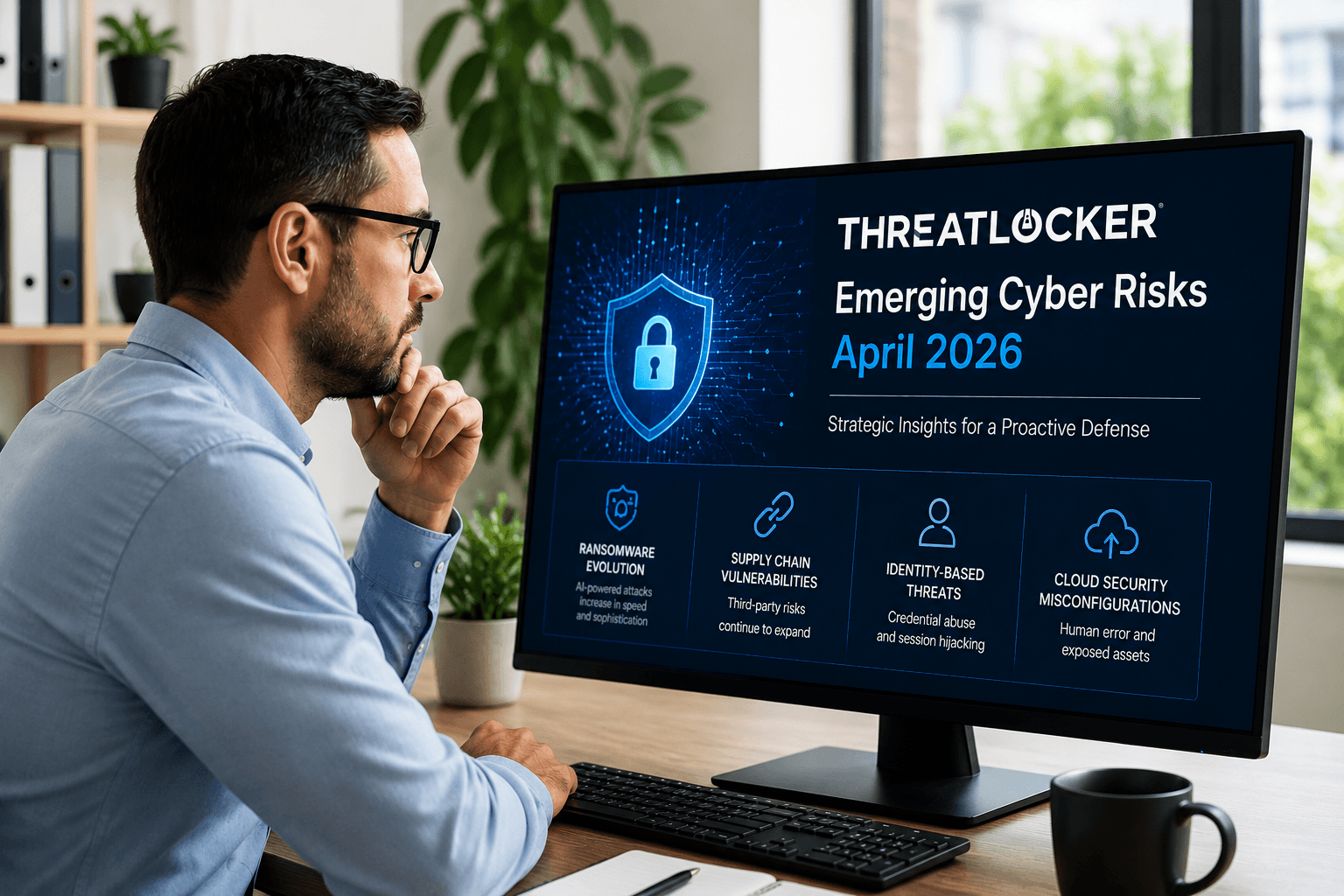
ThreatLocker's April 2026 Threat Recap — AI-Accelerated Attacks, Structured Cybercrime, and Why Detection Is No Longer Enough
April 2026 delivered a sharp reminder of how rapidly the threat landscape is evolving — and how far detection-based security strategies have fallen behind. ThreatLocker, the global cybersecurity leader protecting over 70,000 organisations with its Zero Trust Platform, has published its monthly recap of the most significant cyber threat activity, research, and community engagement from the month. The findings paint a clear picture: AI is accelerating attack creation, cybercrime is becoming increasingly structured and collaborative, and the gap between organisations that rely on detection and those that rely on control is widening every month.
From a landmark AI vulnerability tool called Claude Mythos to the quiet sophistication of a WordPress search ranking manipulation scheme, and from the infiltration of a live ransomware-as-a-service affiliate platform to the rise of what the industry is calling vibe hacking, April's threat landscape was defined by adversaries operating with unprecedented speed, scale, and structural professionalism. ThreatLocker's research teams were in the middle of it all — monitoring, infiltrating, and publishing practical guidance to help organisations stay ahead.
"What we're seeing is a continued shift in how attacks are developed and executed, with AI accelerating how quickly new techniques can be created, while cybercrime operations are increasingly more structured and collaborative. If your security strategy depends on detection, you're already behind. You need to control what can run and what it can do."
— Danny Jenkins, CEO & Co-Founder, ThreatLocker
Key Cybersecurity Trends from April 2026
ThreatLocker's April recap identified five distinct trends that shaped the month's threat activity — each reflecting a different dimension of how AI and structural professionalisation are reshaping the cybercrime economy.
Claude Mythos — A Watershed Moment in AI-Driven Vulnerability Research
Claude Mythos dominated cybersecurity discussions throughout April, with many in the industry calling it a watershed moment due to its unprecedented ability to identify vulnerabilities and generate working exploits. In response, ThreatLocker reinforced the importance of Zero Trust application containment — which restricts what permitted applications and AI-driven tools can access, preventing compromised or weaponised software from executing malicious actions even when it has been granted system access.
Vibe Hacking — The AI-Driven Attack Frontier
ThreatLocker raised significant concerns over the emergence of vibe hacking — a new category of AI-driven attack where threat actors use generative AI tools to rapidly prototype, adapt, and execute attacks that outpace traditional defences. As the barrier to creating functional attack tooling falls with each AI capability release, the speed at which novel techniques can emerge has increased dramatically, compressing the window between a new technique's creation and its widespread deployment in the wild.
The WordPress SEO Hack — Invisible Damage, Maximum Leverage
A significant WordPress compromise drew ThreatLocker's commentary for an unusual reason: the attackers caused no immediate or visible damage. Instead, they quietly injected content visible only to Googlebot — manipulating search rankings to gain SEO advantage with the likely goal of selling that advantage to other actors in the cybercrime economy. This patient, financially-motivated approach signals a growing class of attack designed to extract value invisibly, making detection particularly difficult and the financial incentive to breach persistent even when no ransomware or data theft occurs.
Ransomware-as-a-Service Goes Corporate — Inside the Vect Affiliate Platform
ThreatLocker's Threat Intelligence team successfully infiltrated the affiliate platform of Vect, an active ransomware-as-a-service (RaaS) provider. What they found was striking: the platform mirrors a modern SaaS operation, complete with help-desk ticketing, how-to guides, chat functionality, user outreach systems, and a well-defined affiliate programme. Following the shutdown of major forums like RAMP, a growing network of criminals has migrated to Vect — and the platform's polished, businesslike structure reflects a professionalisation of cybercrime that makes attribution, disruption, and defence significantly harder.
Gamification in Cybersecurity — Turning Awareness Into Engagement
On the defensive side, ThreatLocker highlighted the growing importance of gamification in cybersecurity training and awareness — transforming what has historically been a dry compliance exercise into an engaging, interactive experience that measurably improves security behaviours. This trend reflects broader recognition that the human layer of security is as important as the technical one, and that building genuine security culture requires more than annual awareness modules.
Research Publications — Practical Guidance for the AI Threat Era
Alongside its threat intelligence work, ThreatLocker published several research pieces throughout April focused on emerging attack methods, real-world attack analysis, and practical risk reduction strategies. The centrepiece of the month's research output was a dedicated webinar — "Fighting Back Against AI Cyberattacks: A Practical Zero Trust Defense Playbook" — providing security and IT teams with a concrete implementation guide for deploying Zero Trust controls that directly counter the AI-accelerated threats dominating the current landscape.
These publications reflect ThreatLocker's broader philosophy: the most valuable threat intelligence is not intelligence that describes a problem, but intelligence that translates directly into defensive action. In an era where attack techniques can be created and iterated faster than signature databases can be updated, the only durable defence is one built on control — restricting what can run, what it can access, and what it can do.
Community Engagement — CyberLaunch 2026 and the Cyber Hero Team
April was also a month of significant community investment for ThreatLocker. The company served as lead sponsor of CyberLaunch 2026 — the annual competition that brought more than 500 of Florida's top cybersecurity students from grades 6 through 12 to the University of South Florida in Tampa. ThreatLocker's sponsorship provided financial support covering travel and lodging costs for competing teams. First-place finishers in the beginner, intermediate, and advanced divisions were Kirkland Ranch Academy, West Boca Raton Community High School, and Hernando High School respectively.
Away from the competition circuit, members of the ThreatLocker Cyber Hero Team demonstrated community values beyond cybersecurity — partnering with the Orlando Magic to help build a playground for a local community. This kind of community-level engagement reflects a culture that ThreatLocker has deliberately built alongside its technical platform: the belief that the people defending organisations from cyber threats should also be the people investing in the communities those organisations serve.
Key Takeaways
Claude Mythos marked a watershed moment in AI-driven vulnerability research — demonstrating that the ability to identify and exploit vulnerabilities at AI speed has arrived, and that Zero Trust application containment is now a front-line defensive requirement, not an optional enhancement.
ThreatLocker's infiltration of the Vect RaaS affiliate platform exposed cybercrime's growing structural sophistication — a polished, SaaS-like operation with help-desk tickets, affiliate programmes, and active community growth in the wake of other forum shutdowns.
The WordPress SEO manipulation hack and the rise of vibe hacking illustrate two distinct but converging trends — invisible, financially-motivated breaches and AI-accelerated attack creation — both of which outpace detection-centric security strategies.
ThreatLocker's community investment — lead sponsoring CyberLaunch 2026 for 500+ students and partnering with the Orlando Magic for a community playground build — demonstrates an organisation investing in the next generation of defenders while actively protecting the current one.
April 2026's threat recap from ThreatLocker is a compressed but clear picture of where enterprise cybersecurity stands today. Attacks are being created faster than signatures can track them. Cybercrime is operating with the discipline and structure of legitimate software businesses. And the human layer — from AI vulnerability tools to gamified training — is becoming the most contested terrain of all. The organisations best positioned to weather this environment are not those with the best detection — they are those that never let the threat run in the first place.
To explore ThreatLocker's Zero Trust Platform and access the full April 2026 threat research, visit threatlocker.com.