
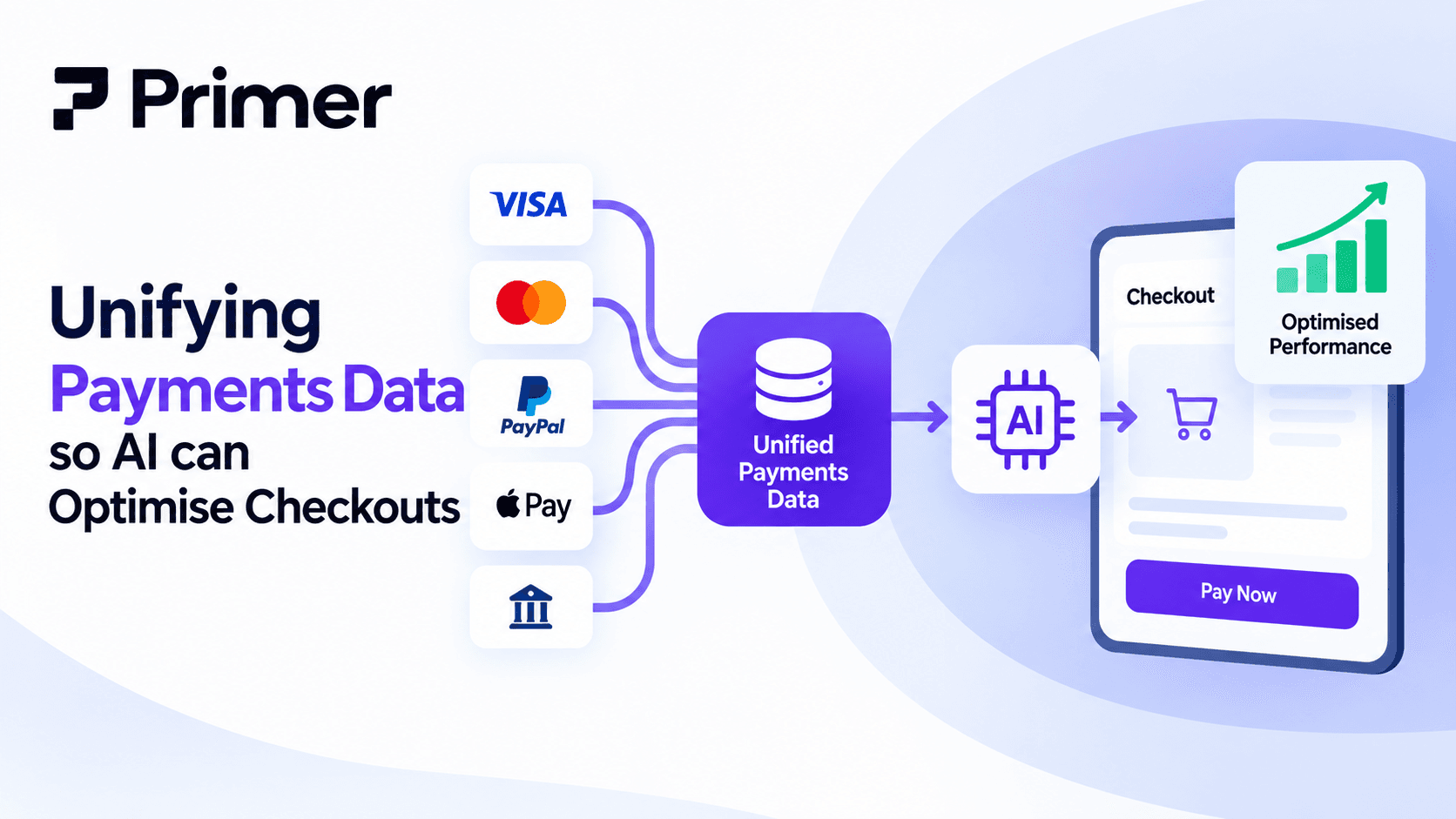
Payments infrastructure company Primer is highlighting the growing importance of unified payments data as merchants increasingly turn to AI to improve checkout performance and payment operations.
As merchants operate across multiple payment service providers (PSPs), payment methods, regions and processors, payment information can become fragmented. Different providers often use different terminology, transaction states, decline codes and reporting structures, making it difficult to build a consistent view of payment performance.
Why Unified Payments Data Matters
Primer argues that AI needs more than a merchant's individual payment feed or a dashboard export to make useful recommendations.
Payment performance can be affected by numerous factors, including:
Payment processor performance
Issuer behaviour
Payment methods
3DS authentication
Geographic markets
Routing decisions
Decline patterns
Checkout configuration
Without connecting these signals, an AI system may identify that approval rates have fallen but struggle to determine why the change happened or what action should be taken.
Primer's platform therefore focuses on standardising payment information across providers. Its infrastructure maps different PSP data into a common structure, allowing merchants to view payment performance across processors and payment methods.
AI Moves From Reporting to Optimisation
The company is also applying this unified data foundation to its AI Companion, an AI-powered payments assistant.
Primer says Companion can analyse payment performance, identify changes and investigate issues such as declining authorization rates, processor performance, payment-method anomalies and geographic trends.
The objective is to reduce the amount of manual analysis required from payments teams.
Instead of exporting data, comparing reports and searching through dashboards, teams can ask questions about their payment performance and receive answers based on the payment context available within Primer.
Improving Checkout Performance
The same data can support checkout optimisation.
Primer's broader platform combines payment orchestration, analytics and checkout capabilities, allowing merchants to use payment-performance insights to adjust routing, payment methods and checkout strategies.
This creates a feedback loop:
Payment data → AI analysis → Insight → Optimisation → Better payment performance
For merchants, the potential benefit is not simply better reporting. The goal is to identify problems earlier and make informed changes that can improve authorization rates, conversion and revenue.
The Challenge of Fragmented Payment Systems
One of the biggest obstacles is that payment data is rarely uniform.
A payment may be described differently by different PSPs, while decline reasons, transaction statuses, timestamps and other fields can also vary.
Primer says that standardising this information requires ingesting data from providers, mapping different payment states and terminology into a shared model, and maintaining that model as providers change their APIs and reporting systems.
That data foundation becomes increasingly important as businesses add more payment providers and expand into new markets.
AI With Human Oversight
Primer's approach also keeps humans involved in payment decisions.
Its AI Companion can recommend actions based on payment data, but the company says the merchant remains in control of what happens next.
This model positions AI as an intelligence layer rather than an autonomous replacement for payments teams.
The Bigger Picture
The development reflects a broader shift in fintech: AI is becoming more useful when it has access to structured, contextual and real-time business data.
For payments, that means bringing together information from processors, payment methods, markets and checkout systems before asking AI to interpret performance.
Primer's strategy is to build that unified data layer and then place AI on top of it, enabling merchants to move from simply understanding what happened at checkout to identifying potential improvements and acting on them.
As AI becomes more deeply integrated into commerce infrastructure, clean and unified payments data could become an increasingly important foundation for intelligent checkout optimisation.