
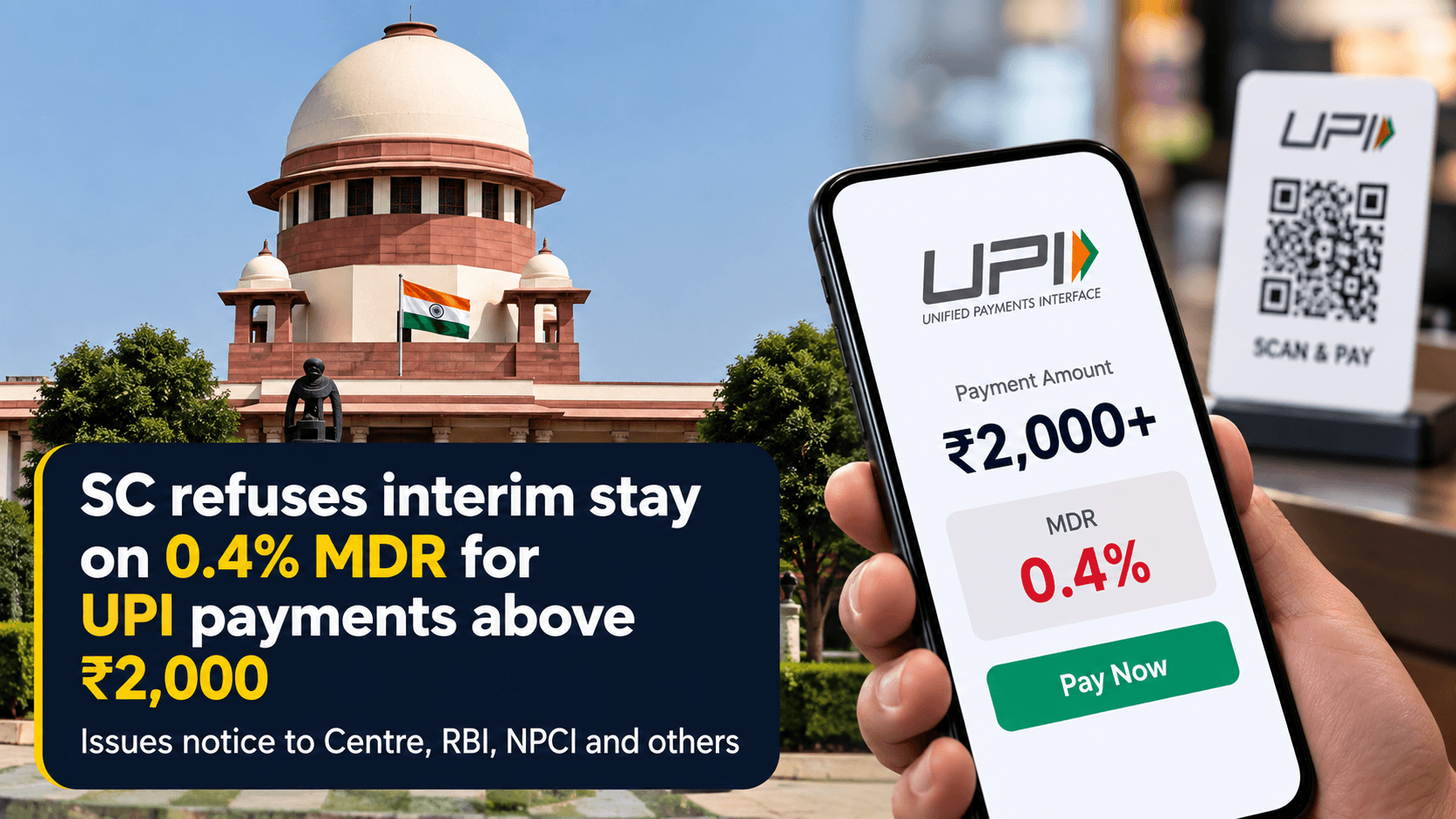
The Supreme Court on September 28, 2026, refused to grant an interim stay on the Centre’s decision to introduce a 0.4% Merchant Discount Rate (MDR) on specified UPI person-to-merchant transactions above ₹2,000.
The court, however, issued notices to the Centre, Reserve Bank of India (RBI), National Payments Corporation of India (NPCI) and other respondents and directed them to respond to the challenge within four weeks.
New UPI MDR Framework
Under the new framework, the 0.4% MDR will apply to eligible person-to-merchant (P2M) UPI transactions above ₹2,000 from October 15, 2026.
The charge will be capped at ₹300 for transactions of ₹75,000 and above. Certain essential and thin-margin sectors will instead be subject to a flat ₹5 MDR, while specific categories have separate provisions.
The government has clarified that person-to-person UPI transactions will remain free, while payments to merchants up to ₹2,000 and transactions covered by the small-merchant exemption will also remain free.
According to the Finance Ministry, approximately 96% of P2M transactions will remain unaffected under the new framework.
Supreme Court Seeks Government Response
The case arose from a public interest litigation filed by advocate Anjan Datta challenging the new MDR framework.
During Monday's hearing, the Supreme Court questioned the basis and character of the new charge and asked the Centre to explain the framework through an affidavit. The bench observed that the matter appeared to involve significant technical considerations.
The court did not suspend the policy while the legal challenge proceeds.
What the New Rule Means for Merchants
MDR is a fee associated with processing digital merchant payments and is distributed among participants in the payments ecosystem rather than being collected as a government tax, according to the Finance Ministry.
The introduction of MDR represents a significant change after several years in which UPI payments operated under a zero-MDR framework for most transactions.
The new structure particularly affects merchants handling higher-value digital payments, although smaller merchants meeting the specified eligibility conditions remain exempt.
UPI Payments Remain Free for Consumers in Most Cases
The new framework does not introduce a direct charge for consumers making eligible UPI payments.
The MDR is a merchant-side charge. However, industry groups have raised concerns about whether some businesses could eventually adjust prices or payment practices in response to the additional cost.
The government has maintained that the framework is designed to support the sustainability of the UPI ecosystem while protecting everyday users and small merchants from additional charges.
What Happens Next?
The Centre, RBI, NPCI and other respondents now have four weeks to file their responses before the Supreme Court.
The court's refusal to grant an interim stay means the new MDR framework remains scheduled to take effect on October 15, 2026, unless there is a subsequent change or further court direction.
The legal challenge will therefore continue to be closely watched by banks, fintech companies, payment platforms, merchants and other participants in India's rapidly expanding digital payments ecosystem.