
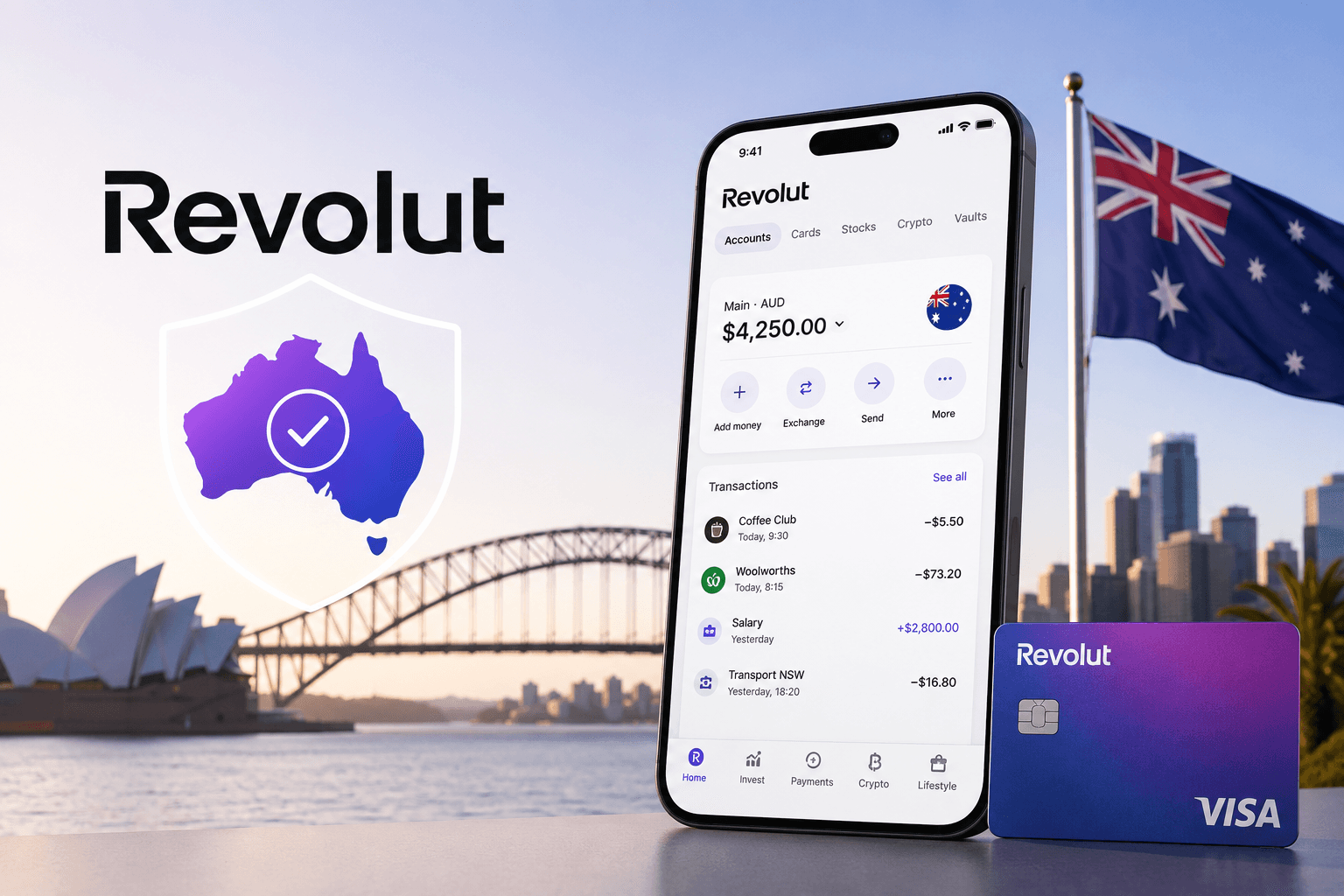
Revolut Wins a Full Australian Banking Licence — and Commits AU$400m to Back It
An unrestricted ADI approval opens the door to savings and credit products, and gives the fintech its first licensed bank anywhere in Asia-Pacific.
The Brief
Australia's prudential regulator has granted Revolut an independent, unrestricted Authorised Deposit-taking Institution licence — the first full ADI held by a global fintech in the country and Revolut's first licensed banking operation in Asia-Pacific. The company plans to put close to AU$400m into the market over five years, will migrate existing Australian customers automatically, and can now offer interest-bearing savings and credit alongside its current products. Australia joins the UK, EEA and Mexico in a licensed-bank network that Revolut is still pushing to widen.
A licence is not a launch, but in banking it is the thing that decides what a company is allowed to become. Revolut has just cleared that gate in Australia, and the shape of its local business changes with it.
The Australian Prudential Regulation Authority has issued the fintech an independent Authorised Deposit-taking Institution licence — unrestricted, and the first of its kind awarded to a global fintech in the market. It is also the company's inaugural licensed banking operation across Asia-Pacific, ending a long stretch in which its regional presence ran on narrower permissions.
What the approval buys
An unrestricted ADI lets Revolut Bank Australia hold deposits in its own right and build the interest-bearing and lending products that a payments-and-cards proposition simply cannot reach.
In practical terms, savings accounts that pay interest and consumer credit facilities can now sit next to the existing core offering. That is the commercial argument for the years of regulatory work: deposits fund lending, lending generates margin, and both deepen the relationship with customers who might otherwise treat the app as a travel-money tool.
Existing Australian retail and business customers will be moved across to the licensed entity automatically, with nothing required of them, while new sign-ups will be onboarded straight into Revolut Bank Australia. Deposits held with the bank fall under Australia's protection framework, including the Financial Claims Scheme, which covers eligible balances up to AU$250,000 (around US$175,000) per account holder.
The money behind the licence
Regulatory approval comes attached to a spending commitment: close to AU$400m, roughly US$280.6m, directed into Australia over the next five years.
That capital is earmarked for local product development, scaling operations and hiring — the unglamorous infrastructure of running a bank in a market rather than servicing it from abroad. It signals that the licence is meant to anchor a domestic business, not simply add a badge to a global map.
Founder and chief executive Nik Storonsky framed the Australian bank as a long-running strategic priority and another step toward building what he calls the world's first truly global bank, arguing that clearing the bar in a market this heavily regulated and competitive validates both the model and the teams behind it.
Clearing a market this regulated is the proof point — a global bank has to be built licence by licence, not announced. — On what the Australian approval signals
Matt Baxby, who leads Revolut Bank Australia, described the milestone as a launchpad rather than a destination — the point from which a broader product suite spanning savings and credit can be built out around the services customers already use, with the stated aim of delivering the most seamless and secure banking experience for Australian consumers and businesses.
Where Australia fits in the wider map
Australia now sits alongside the UK, the EEA and Mexico in Revolut's set of fully licensed banking markets — a small but growing club that defines where the company can operate as a bank rather than a fintech partner.
The approval follows the launch of Revolut Bank in Mexico, its first banking entity outside Europe, which has already gathered more than 500,000 retail customers. Further applications remain in play: a bank charter bid in the US, new licences in the UAE, and an Organisation Authorisation in Peru.
In Europe, the company has been reshaping its banking leadership and structure, appointing former Chase UK chief executive Kuba Fast to run its European banking operations after earlier approvals from the European Central Bank and the Bank of Lithuania. Its regional strategy now runs on a dual-hub model, pairing the Lithuanian headquarters with a newly established French base. Across more than 40 markets, the company serves upwards of 45 million retail customers — a base that increasingly needs licensed entities beneath it to be monetised properly.
Key takeaways
- Unrestricted beats restricted. A full ADI lets Revolut hold deposits outright and add interest-bearing savings and credit — products a limited permission cannot support.
- APAC now has a foothold. This is the company's first licensed banking operation anywhere in Asia-Pacific, converting regional presence into regulated capability.
- Capital signals intent. Close to AU$400m over five years, aimed at local product, operations and headcount, points to a domestic build rather than a remote-serviced market.
- Migration is frictionless by design. Existing retail and business customers move to the licensed entity automatically, with new deposits protected up to AU$250,000 per account holder.
- The licence map keeps widening. Australia joins the UK, EEA and Mexico, with US, UAE and Peru applications still live — each one unlocking a different tier of what the app can legally do.