
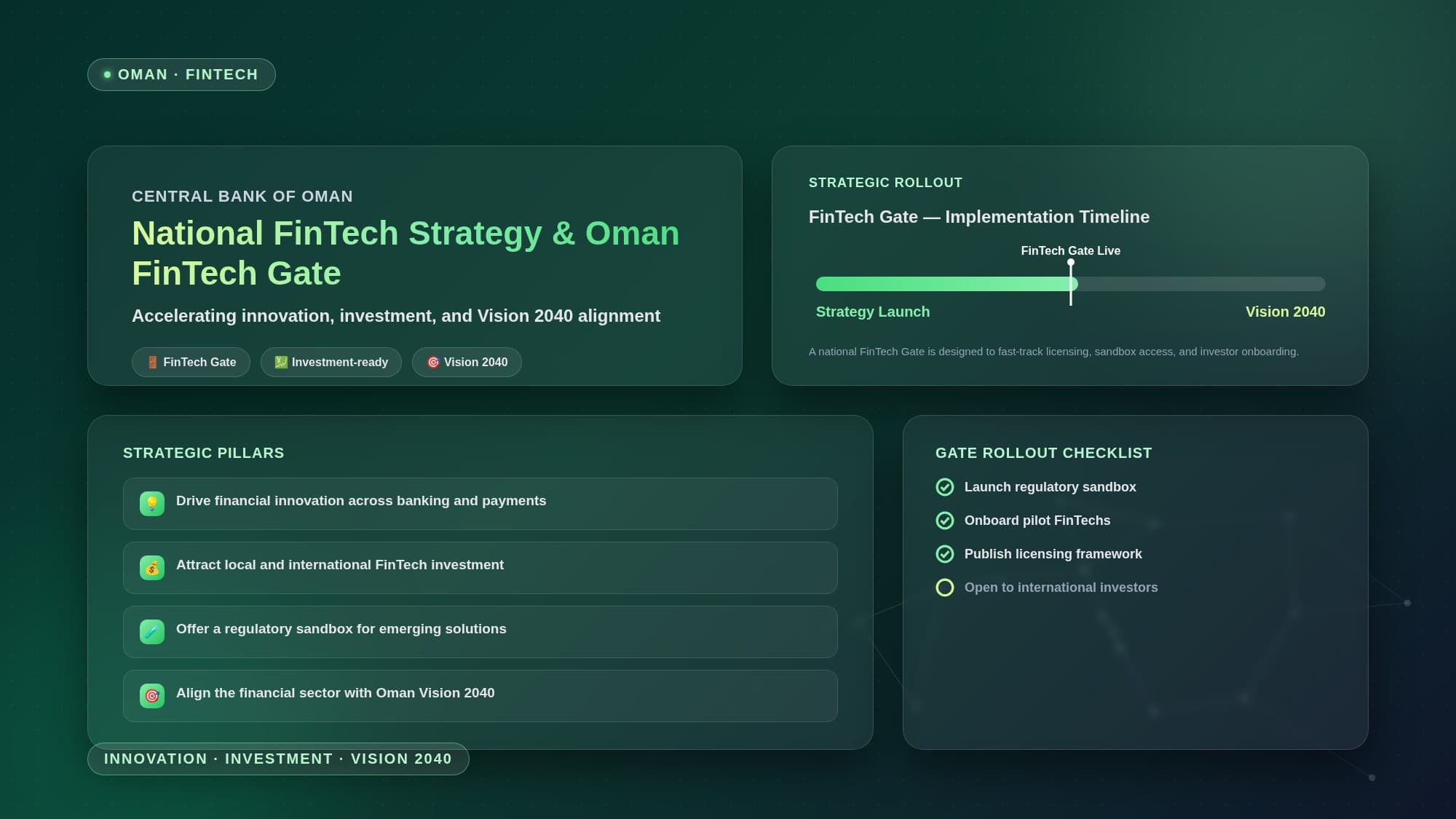
The Sultanate of Oman has launched a National FinTech Strategy and the Oman FinTech Gate to centralise its digital finance ecosystem. For fintech professionals, this represents a significant regulatory shift toward a unified, innovation-friendly environment designed to attract international investment and streamline the path for startups to scale within the Middle Eastern market.
What was announced
The Central Bank of Oman (CBO), in partnership with the Financial Services Authority (FSA) and the Ministry of Finance’s "Estidama" programme, introduced two major initiatives to modernise the nation's financial sector. The National FinTech Strategy serves as a structured roadmap to align public and private sector priorities, focusing on financial inclusion, cybersecurity, and the development of a digital economy in line with Oman Vision 2040. It establishes a unified national direction for developing the ecosystem and defines a roadmap for coordinated implementation across various government bodies.
Central to this rollout is the Oman FinTech Gate, a dedicated digital platform integrated with the Invest Oman platform. It acts as a central point of entry for domestic and international entrepreneurs, providing guidance on applicable requirements and connecting applicants with ecosystem partners. The platform is designed to reduce market fragmentation and offer a more transparent, efficient pathway for firms to assess their readiness and advance toward regulatory engagement.
While the CBO will oversee the overall implementation of the strategy, the FSA will continue to manage innovation within non-banking sectors, including capital markets, insurance, and auditing. The initiative involves a broad coalition of partners, including the Ministry of Commerce, Industry and Investment Promotion, the Ministry of Transport, Communications and Information Technology, and the Small and Medium Enterprises Development Authority. The strategy aims to foster an environment where Omani entrepreneurs can develop and scale solutions locally and internationally while maintaining financial stability and consumer protection.
"The launch of the National FinTech Strategy marks a defining step in Sultanate of Oman's financial transformation. It extends far beyond the adoption of new technologies; it represents a national commitment to building a financial system that is more innovative, inclusive, competitive and capable of anticipating the needs of a rapidly evolving digital economy."
Ahmed Al Musalmi, Governor of the Central Bank of Oman.
The companies involved
The Central Bank of Oman (CBO) is the primary monetary authority for the Sultanate, responsible for maintaining financial stability and overseeing the nation's banking infrastructure. Under the leadership of Governor Ahmed Al Musalmi, the CBO has increasingly focused on digital transformation and the integration of advanced financial technologies into the local market. It serves as the lead coordinator for the new national strategy.
The Financial Services Authority (FSA) serves as the regulator for Oman’s non-banking financial sectors. Led by Chief Executive Officer Sheikh Abdullah bin Salim Al Salmi, the FSA oversees capital markets, the insurance industry, and accounting standards. Its role in the new strategy is to ensure that innovation in these sectors remains compliant while encouraging the adoption of new business models that respond to evolving customer needs.
The Ministry of Finance supports these efforts through the National Programme for Fiscal Sustainability and Financial Sector Development, known as "Estidama." This programme, supervised by Secretary General Mahmood bin Abdullah Al Owaini, is a critical component of Oman’s broader fiscal strategy to diversify the economy away from oil dependency and build a sustainable digital infrastructure in alignment with the Oman Vision 2040 goals.
What FF News has reported before
FF News has previously tracked the regulatory evolution within the Sultanate, particularly regarding the non-banking sector. We reported on how the FSA Issues New Regulation for Insurance Loss Assessment and Risk Estimation, highlighting the authority's move toward more structured oversight in the insurance space. This latest fintech strategy builds upon such foundational regulations by creating a more cohesive environment for technology-driven financial services. While Oman strengthens its domestic framework, the wider region is also seeing increased activity in digital asset standards and compliance, as seen when Bitazza Thailand Achieves Travel Rule Readiness with Sumsub Ahead of SEC Enforcement, reflecting a global trend toward more rigorous digital governance.
What this means
Oman’s move to consolidate its fintech entry points via the Oman FinTech Gate is a direct response to the fragmented regulatory landscapes that often hinder Middle Eastern expansion. By integrating the gate with the broader Invest Oman platform, the Sultanate is positioning itself as a "trusted bridge" for firms looking for a clear, predictable regulatory path. This puts pressure on neighbouring jurisdictions to further simplify their own licensing processes to remain competitive. However, the success of this strategy hinges on whether the CBO and FSA can maintain their statutory independence while delivering the promised "agility." The industry will be watching to see if this unified framework actually accelerates speed-to-market for complex cross-border solutions.